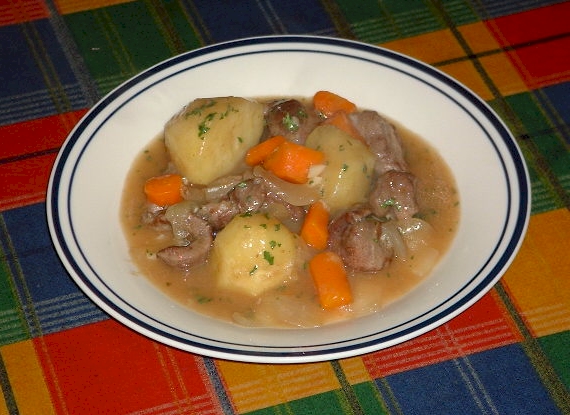
When I first visited Ireland around 12 years ago, I was under the impression that I would land at the airport, head to the hostel and seek out a delicious authentic Irish stew and some offal dish, like steak and kidney pie. The first opportunity that my companion and I had to eat, we found a restaurant that offered the said “authentic” Irish stew. It was gross; a thin, weak broth covering fatty and tough bits of beef with minimal vegetables. If something that should be flavorful and thick, filling and fragrant was so repulsive, I couldn’t imagine what a steak and kidney pie would taste like. I made the quick decision to avoid it.
This doesn't represent what the bad Irish stew looked like
After a bad meal in what we discovered to be a tourist trap, we asked our front desk clerk at our hostel for suggestions. Our clerk apologized for the unsatisfying meal and gave us leads for better places to eat. With those tips, we found that Irish food was good and tasty. Irish chefs have a great craft and work very hard to make fantastic meals. Outside of the traditional fare, Ireland also offered us great options in Italian, French, California, Mongolian and more.
Now reminiscing before my return to Ireland, I’m looking forward to sampling three favorite Irish treats: brown bread ice cream, chips and curry, and Guinness.
Schooled on the local tourist traps, our hotel clerk encouraged us to go to Temple Bar, Dublin's cultural quarter. The area has preserved its medieval street pattern including many narrow cobblestone streets. Wondering though, we found a charming yellow building that houses the Oliver St. John Gogarty Bar & Restaurant. There is where I came across brown bread ice cream; the thick egg-laced vanilla ice cream blended with brown bread caramelized in butter and brown sugar. The custard-like constancy pairs well with the nutty and sweet nuggets of the bread. It was so good that when I returned to Dublin from my trek around Ireland, I headed to Oliver St. John Gogarty to have a light meal and the great dessert again.
Drinking was our night time activity, but in moderation. Yet, several late nights ended up with us looking for chips and curry. I joked that chips and curry serves the Irish like a cheesesteaks serve Philadelphians after a good night out at the bars. The best chips and curry are thin cut fries, fried in peanut oil usually, that are crispy outside and tender on the inside. The soft potato inside sops up the rich curry sauce, a warm pungent gravy with hints of heat from chilis and black pepper, smoke from cumin, floral notes from coriander and cardamom, and sweet flavors of cinnamon and clove that reach over the lightly salty and savory base. There were enough Pakistani and Indian shops that were open after midnight to feed our new craving, but we were lucky enough to discovery Abrakebabra, Ireland’s Premier Fastfood Chain, early on in our trip. With our find, we could at least get a consistently well-favored curry for our fries. (Which by the way, we originally found after our first meal at Oliver St. John Gogarty after asking the security guard for chips and curry and following his directions of guh doun t’uh shtreet, make uh luhft, t’en uh rauht, guh doun fuh’ uh bit’ an uht’s t’air.)
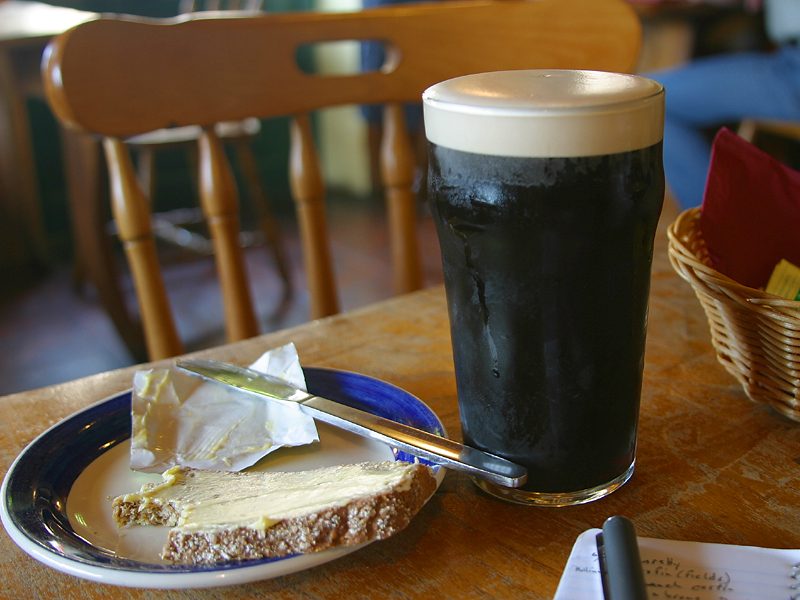
Guinness and Brown Bread (before crumbled into ice cream)
Rounding out the troika is Guinness, the beer of Ireland (or at least Dublin… Don’t ask for one in Cork; that’s Beamish territory!) I can’t wait to get my hands on a pint of the world's most famous stout. I can imaging it now. I order my beer and wait for the bartender to properly pour my glass. The black brew with red tones is served to me in a pint glass and its creamy head forms by bubbles that seem to be floating downward. I bring the Guinness to my lips. The surprisingly light mouth feel in spite of the dark color washes over my palate and eludes to hints of malt, molasses, coffee, chocolate and burnt caramel with a dry, almost peaty aftertaste. After my first big sip, I relish the first shallow and place my pint down. I fill out my fantasy from my memories from my last trip and I spy the bar and take in the patrons’ actions and shake my head, since these young adults are ordering their favorite imported beer, Budweiser.
It's a shame that they waste their euros and calories on that. Oh, I never had an offal dish either.
Images, except where noted, are courtesy of Wikipedia.
Last night, Piers Morgan focused some time on his show about the Hurricane Irene coverage, asking the pithy sound bite: Hurricane or Hype? The crux of this question centered on whether or not the media’s coverage and government’s reaction was too much. I made my opinion about this topic in the middle of the storm.
While news anchors are prone to sensationalism, the coverage and reactions were apropos for a storm of this magnitude. While I am one of the first people to criticize weathermen for their inaccurate predictions – which is usually about a snow storm that doesn’t cancel school the next day, I do understand that they are reporting on predictions. Meteorologists use complicated weather models to make educated guesses about the tracks of storms. By nature, to predict is to estimate or calculate in advance; there is nothing certain about it.
Hurricane Irene's path
Looking back on two storms that have wove their way into the collective memory, I think that we’ve improved on our coverage. There have been lessons to learn after each storm, but there is always more to learn.
Hurricane Andrew in 1992 taught us some serious lessons about reporting. The media’s attention was on Miami, the most overdue city for a hurricane, but the destruction was south of the Gateway to the Americas. This monster storm leveled Homestead, FL. Yet before this fact was known, reports celebrated that Miami dodged a bullet. It wasn’t until the storm had moved into the Gulf of Mexico that information about the damage in South Florida started to come to light. The media had focused on the big city in harm’s way, but neglected the actual location of landfall. This storm was the costliest Atlantic hurricane in U.S. history until 2005.
Andrew making landfall
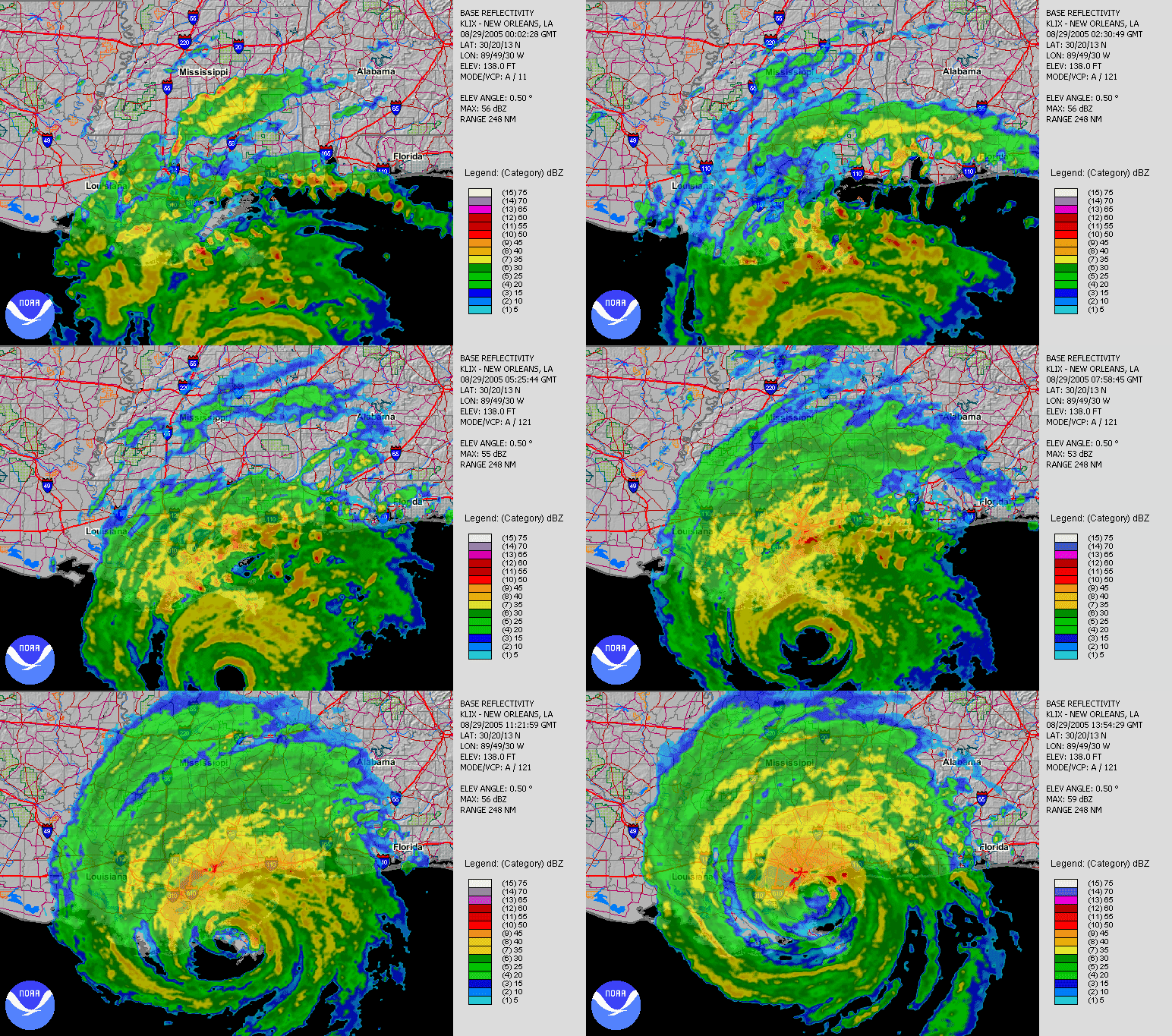
As you know, the costliest U.S. hurricane is 2005’s Hurricane Katrina. While Andrew did serve as a wakeup call, we took very long to act on it. I remember as late as early 2005 watching shows about the Hurricane preparedness of New Orleans which highlighted the vulnerable position that the Crescent City lies between the Mississippi and Lake Pontchartrain. Originally the site of Native American portages between the two bodies of water, the Big Easy rises up from below sea-level to be one of the great American cities. This time, the media was focused on the eye of this storm and not only the largest possible target city. When Karina made her third and final landfall on the Louisiana-Mississippi border, east of this great American city, there was a huge sense of relief that the storm didn’t deadhead into the city. Yet it was the wind, rain and storm surge that followed, coming from the western portions of the storm, which broke the levees and caused the cataclysmic devastation. The failure of the levees remains a huge black eye on United States Army Corps of Engineers.
Prior to Katrina that year, Hurricane Cindy hit Louisiana and caused New Orleans’ largest blackout since Hurricane Betsy in 1965 but that storm was touted to be bigger and more destructive than it was. While Katrina’s hit was impending, Mayor Nagin did order the first ever mandatory evacuation of the city. Unfortunately, many ignored it or waited until it was too late. Those who survived admit that they had become nonchalant about hurricane threats since storms had missed the city for decades.
Hurricane Katrina is a defining moment of our American history. The loss was eminence; it is the costliest U.S. hurricane. In the aftermath, people felt that the government didn’t do enough for our citizens and to this day many New Orleanians still suffer from Katrina's long lasting effects.
Katrina making its second landfall (first landfall was in Florida)
This leads me to this past week. As Katrina serves as one of our American tragedies with over 1,800 dead, her scope was small compared to Irene’s enormous projected danger zone. There were an estimated 65 million people who were in Irene’s path this last week in the U.S. mainland alone, not including Puerto Rico, the Bahamas, Jamaica and Canada. This storm was notable, like Katrina, in making three landfalls, first around Atlantic Beach, NC, the second in New Jersey by the Little Egg Inlet and the last in Coney Island, Brooklyn, New York. This made Irene the first hurricane since Agnes in 1972 to make landfall directly in New York City.
While the storm ended up being less destructive than predicted for most of the 65 million people, our fellow country men and women in North Carolina, upstate New York and Vermont have suffered greatly. Since North Carolina took the first brunt of the storm and Irene stalled over the Pamlico Sound, the storm lost the wind punch that could have shattered New York upon its direct hit. Yet Irene was still a rainmaker and most of the East Coast was under a flood watch or warning during the storm’s lifespan. Many small towns in the New England area have been flooded off the map. The ruin left behind is unfortunately record breaking.
Irene over North Carolina
Most of the coverage seemed to highlight New York and New Jersey during Sunday. However the storm hit North Carolina on Saturday and the coverage came in from Atlantic Beach, Nags Head and Virginia Beach then. As Irene trekked up the New York – Connecticut border, the reports followed her track.
No one could truly predict Irene’s behavior when she made her multiple landfalls. I think that stations were being responsible in reporting how bad the damage could be and demonstrating how vicious her wake was. I’m glad that our elected officials handled the situation with gravitas and mandated evacuations. I don’t fault and I support the EMS manager in New Jersey who warned those who didn’t heed the order to “take a 3x5 card, use indelible ink and write your name, Social Security Number, Date of Birthday, next of kin, way to reach them on the card. Then place the card in your left shoe, not a flip flop or a sandal, so we can identify you whenever we find your body.” Those who couldn’t leave on their own accord were offered assistant to get out of harm’s way. Those who choose to stay behind are selfish, and they make matters worse in endangering the brave men and women who are then charged with saving them when they do find themselves in trouble.
Flooding in Brattleboro, VT, courtesy of CNN iReports
Finally, to those who think Irene was blown out of proportion, shut up. Instead, pray for the 37 victims and their families. Thank your God that you didn’t suffer in wake of the storm and pony up some relief to our follow Americans who were devastated by the Hurricane. And who knows, we may all get pummeled by Katia.
After the waterlogged weekend that we had on the East Coast, I’d like to take a trip to the desert. Seeing the Schuylkill flooded carrying debris and speeding out to the Delaware made me long for someplace dry and arid. For me one of the more famous and accessible desert is the two-desert Joshua Tree National Park.
An eponymous Joshua Tree
I’ve been to Joshua Tree in the winter of 2006. It was an ambitious day trip that I took with my friend, Denise. I had a red eye flight to take back to Philadelphia so we left early in the morning to make the 2 ½ hour trek out to Twentynine Pines.
A rock formation along Park Boulevard
Clichédly, we queued up the U2 as we got onto California Route 62 and followed the sign to the Park. The entrances from 62 put you into the Mojave Desert, the habitat of the Joshua Tree. The name sake of the park was named by Mormon settlers because the shape that reminded them of a Biblical story of Joshua praying with his hand up in the air.
Ecologically, this park is unique for the meeting of the two deserts. We entered the park through the Mojave Desert, which is generally the higher, drier, and slightly cooler of the two. The landscape features bare rock hills peppered with loose boulders and sparsely vegetated flatland. To our east is the other desert – the Colorado Desert, part of the larger Sonoran Desert, which features scrub and cactus.
View from Ryan Mountain
The park offers a lot to see. In our foray, we drove through the Mojave, taking in the vast land and pointing out many of the Joshua Trees. We spied down several of the trails that intersected the main roads, but we knew that our time was short. We headed to climb Ryan Mountain and catch a glimpse of the Colorado Desert. In the distance, there looked a like a noticeable different between the flora around us and what was off in the east. However, time was short and I would need to return to Los Angeles, get my bags and return the rental car before my flight. We descended back to the car and I knew that I would plan to return
Another Joshua Tree with San Gorgonio Mountain, Southern California’s highest peak, in the background
From the NPS site, short visits of a ½ a day or less should involve the main park roads with many pullouts for wayside exhibits to learn more about Joshua Tree. On a clear day, the NPS suggests the Keys View which vista looks beyond the Salton Sea to Mexico. For a full day, there is time to discover the Park on foot, either on one of the guided tours or on a solitary backcountry hike. Also the park has nine campgrounds for an over-night visit and for the most adventuresome, backcountry camping is permitted. For me, my ideal visit would be a day in park from opening to close and a comfortable night in Palm Springs.
Today the east coast felt a noticeable earthquake from North Carolina to Ontario. According to government sources, the quake was centered near Mineral, VA about 40 northwest of Richmond. Through twitter and the iPhone, my colleagues and I were able to confirm what we felt in a matter of minutes from the safety of outside our building.
What remains funny to me is the development of the Wikipedia article from its anonymous contributors.
At the end of the Impact section: "Barack Obama transformed into a robot"
This inaccuracy was noted and edited out, probably multiple times before I refreshed to read the updated version.
Casualties: 9001 squirrels
That's a lot of dead squirrels. I have a difficult time believing that many rodents died; they seem to be able to sense an upcoming disaster and tend to act accordingly.
A more credible version
It seems that after several iterations, the anonymous authors and editors have been able to cite the appropriate stories to bring credibility to the article. For the latest version, visit the page directly at 2011 Virginia earthquake. It's amazing how fast social media works.
There are so many places in Canada that I’d like to see. Having only been to Toronto, Montréal, Vancouver and Calgary, for example, are on my list. Yet, I’d like to visit the capital next.
Ottawa is in nestled in the Ottawa River Valley in eastern Southern Ontario, bordering on Québec. This location has made the National Capital Region of Ottawa and Gatineau a bilingual area with a diverse population. Home to the National Government, the city is a mixture of formalistic and functional architecture with a good helping of Romantic and Picturesque styles, too.
Central Block, Parliament Hill
Like our capital, Washington, DC, history is rich in this planned city that Queen Victoria chose as the capital for the Province of Canada (comprised of parts of modern day Ontario and Quebec) on December 31, 1857. The city is the site of the northern terminus of the Rideau Canal, the oldest continuously operated canal system in North America and a UNESCO World Heritage Site. The canal was opened in 1832 as a precaution in case of additional war with the United States.
After the War of 1812, British forces learned that the US has planned to invade the confusingly named colony of Upper Canada* via the St. Lawrence. The British built the canal to keep commerce and communications open between Montréal and the British naval base in Kingston, ON. Today, the Canal is also famous as being one of the largest fresh water skating rinks in the winter.
The Canadian Museum of Civilization
As a Commonwealth Nation, they honour (wink) the British monarch as their sovereign. In June 1959 Canada accepted ten heraldic statues, The Queen's Beasts, that Ministry of Works commissioned for Queen Elizabeth II to depict her genealogy for her conoration. Being cast in plaster, the statues could not left in the open air and they were shipped between Hampton Court Palace, Windsor Castle and, finally, storage. The British Government decided to offer them to the Commonwealth Governments and Canada, being the senior nation, was offered them first. The beasts now reside at the Canadian Museum of Civilization in Gatineau. I don’t know if they display them or not, but I would love to visit for a public showing of these statues. There are replicas of The Queen's Beasts on display at Kew Gardens, if I can’t see the originals in Canada.
The Queen's Beast - The Unicorn of Scotland, courtesy of Call to Arms...
Beyond the Queen’s Beasts, the Canadian Museum of Civilization serves to collect, study, preserve, and present material objects that illuminate the human history of Canada and the cultural diversity of its people. The building, reminiscent of the Smithsonian’s National Museum of the American Indian in design and architecture,is Canada’s most popular and most-visited museum.
Across the river from the Museum stands Parliament Hill, where Gothic revival buildings, including the commanding Centre Block, serve as the home of the Parliament of Canada and the center of Canadian politics. Though Ottawa is the capital for the Confederation, Pierre Trudeau worked to increase the number of more federal workers based in the Quebec side of National Capital Region. To the end, the Central tower of the Terrasses de la Chaudière is now the area’s tallest building.
On the Rideau Canal
In writing this blog entry, I realize that there are many parallels between Washington, DC, and Ottawa, including that the largest buildings are outside of the city proper. They share in being deliberately established between the boundary of two different demographic types, (i.e. the more agricultural south and the more Industrial north for the US and the Anglophonic Upper Canada and Francophone Lower Canada). As I love Washington for its history and its cache of American identity, I know that I will be charmed by Ottawa’s share of Canadiana.
Images, except where noted, are courtesy of Trip Advisor.
* Upper Canada was the southern portion of Ontario, while Lower Canada was southern portion of Quebec and region of Labrador. Therefore Upper Canada is South-southeast of Lower Canada. The naming convention came from the direction of the Saint Lawrence, as Upper Canada was further along the waters of the river. In 1841, these two colonies became the Province of Canada.
During this muggy summer when Philadelphia's temperature hit the century mark, my cousin and I fled for the Poconos to a day of respite from the oppressive heat. We visited the town of Jim Thorpe and spent the day exploring the Carbon County borough. After a leisurely visit, we decided to take an as relaxed drive home via US 209 South to PA 309 South. We were only the road for about 15 minutes when we saw the golden domes of this Church poke up through the cluster of homes in the town of Lansford.
We drove around to find the best way to access the church, finding all the one way streets in the direction other than we wanted. Eventually, we stopped in front of the St. John the Baptist Byzantine Catholic Church and were able to the snap a picture of the building, avoiding all the overhead electrical wires. This is the fruit of our labor.
According to the Bourbon Blog, yesterday was National Rum Day. In honor of the wonderful day (for the Rum AND Madonna’s birthday), I wanted to share with you an intense mojito from the Rum Bar in Philadelphia.
My friend, Necie, and I decided to go hit a bar to meet up and swap the book for our upcoming bookclub. It was Monday and I knew that Rum Bar had ½ price mojito special then. We studied the extensive menu of drinks, and I chose the chili coriander mojito.
Instead of mint, this mojito was muddled with cilantro (a.k.a. coriander) leaves in a chili pepper infused rum. It was innocent looking, but this drink packed a punch. The flavor starts sweet and citrusy from the simple syrup and lime juice as the bouquet of the cilantro grows – the fresh, green, bright taste. Finally the peppery taste joins and intensifies in heat, leaving a warm burn in the back of the throat that slowly dissipates, but does come to an end. It was a concentrated, intriguing drink for the night.
An innocuous looking mojito
I toned the heat down with my second drink, a West African Booty. The lure of a drink flavored with grains of paradise, a West African spice that is reminiscent of ginger, was too much to resist. (Not to mention getting to order a drink with the word "booty" in it. Remember it's a rum bar - lots of pirate and sailor references here.) Unfortunately, the heat from the gingery grains of paradise didn't match up with the heat from the chili. Next time, I'll save the potent chili coriander mojito for last.
Rum Bar is located at 2005 Walnut Street, Philadelphia, PA.
In honor of Madonna's birthday, I wanted to share my favorite songs of hers - a top ten list.
10) “Dress You Up” In the height of her “Boy Toy” phase, Madonna shows off her 80’s fashion flare, dancing and performing in this concert footage video for her final single from Like a Virgin. This was the first time that a Madonna song really stuck with me. I enjoyed "Borderline" and "Like a Virgin," however this was her first pop song from her collection that aged well and is still a great song today.
9) “Causing a Commotion” I remember being 14 and dancing around in my room to this song when it first came out in the late summer of 1987. I got a radio that previous Christmas including the big bulky headset earphones who pads surrounded your ears, and I would listen to the radio when going asleep. Even in twilight dream like state before passing out completely, I would perk up when I heard the song and jump out of bed and dance. Of course, this was much to my parents’ chagrin, since they wanted me asleep.
8) “Oh Father” This song is a troubling and moving ballad about personal lose and deep sadness that always haunted me. Then add to that David Fincher’s brilliant video with the images of the mother’s lips sown up, the perils spilling on the floors and a little girl’s shadow being cast from an adult Madonna.
7) “Fever” The only cover on my list, “Fever” was an inspired add to Erotica’s song list. While in the final stages of production for a different unreleased song, Madonna suddenly started singing the lyrics to "Fever" over the top of it. She liked the way it sounded so much that she recorded it and the rest is history.
6) "Amazing" I follow up the only cover on my list with the only unreleased song on this list. The song from Music was one of the first songs leaked on the web as well as Warner Bros. wanted "Amazing" as the fourth single, but Madonna felt the catchiness and sound of "Amazing" was too similar to "Beautiful Stranger" and she thwarted Warner Bros. attempt to release it. I like the hypnotic sound of the song and its lyrics talking about a giddy infatuation. “It’s amazing what a boy can do, I cannot help myself.”
5) "Nothing Fails" This powerful love song with a gospel element harkens to one of Madonna’s most influential album, Like a Prayer. This song was not a released as a single from American Life. However it was treated as an EP in Australia and therefore made it onto the ARIA, Australian Recording Industry Association, charts as a dance album. The song is an infectious love song that crescendos into a redeeming chorus that makes the non-religious want to pray.
4) "Miles Away" Perhaps this song is the other side of the "Nothing Fails" coins. When distance seems to improve the relationship, you are miles away from each other when you’re standing right there. The song has all the hallmarks of Justin Timberlake’s production with vocal percussion in the intro that brings the listener into a melancholy song that touches on the pain and heartache of losing your love in downtempo electronic style.
The Troika of Madonna: These three songs are tied as my favorite Madonna song of all time. Since I can’t rank them, I will order them in reverse order of their release.
(tied) 1) "Don't Tell Me" Madonna’s brother-in-law, Joe Henry, was prodded by his wife, Melanie Ciccone, to send the demo for his song “Stop” to Madonna because Melanie thought that her sister would like the song. Madonna enthusiastically worked on the song with Mirwais to create the string and progressive electronic dance music song that inspired the cowboy-themed video. Upon hearing Madonna’s version of the song, Joe was rather shocked that not one word of the lyrics was altered.
(tied) 1)"Ray of Light" This song is Madonna’s defining moment. After working on Evita and being slammed for Dita-personaed Erotica and the hodge podge of collaborators on Bedtime Stories, Madonna created her second extremely personal and biographical studio album. Based on Curtiss Maldoon’s "Sepheryn,” “Ray of Light” heralded Madonna’s first significant Grammy and still works to get me out on the dance floor.
(tied) 1)"Like a Prayer" This eponymous single from Madonna’s first extremely personal and biographical studio album establishes Madonna as the icon for the 90’s and beyond. Mixing religion fervor and sexual themes, she creates audio ecstasy for the listener that is mirrored in her controversial video. The like "Nothing Fails," "Like a Prayer" embraces the crescendo of a triumphant chorus to punctuate the joyful rapture of being redeemed by love when you only but ask.
"Ray of Light" and "Like a Prayer" both touch on the idea of “feeling like home.” The sensation of knowing that everything is alright is one of mankind’s most important spiritual needs. I don’t think it’s any accident that these two songs and their album have had the impact on Madonna and popular culture that they have. Whether or not they started out as original song or others’ lyrics, the songs have become to express an individual’s journey from being incomplete to whole. When someone is fortunate enough to feel that inner peace that they are complete and at one with their standing in life, the relief is amazing.
As an honorable mention, I wanted to add along the version of "Like a Prayer" from the Sticky and Sweet Tour. It is a little more broody that the original, containing elements of "Feels Like Home" by Meck. This sample darkens the tone of the ecstasy and underscores the inward and sometimes turbulent trek of getting to where "it feels like home."
Happy Birthday, Madonna. Thank you for your music.
I subscribe to several travel e-mail magazines, including Budget Travel. I enjoy their articles and I get the newsletter about twice a week. This past Thursday, I noticed a link in the newsletter, "10 Natural Wonders to See Before They Disappear," and read along in wonder. The article lists natural wonders which are threatened with non-existence within the century and includes suggestions for tour operator at each destination to take advantage of the amazing features of each destination.
Surprisingly, I have been to one of the locations on the list, the Dead Sea. When I was a freshman at Penn, I had the opportunity to travel to Israel in 1992. During my trip with the Penn Glee Club, we spent a day in Ein Gedi and played in the therapeutic waters of the Dead Sea. I never dreamed to get to the highest spot on earth, but I have made it to the lowest. The group took the prerequisite pictures of us floating, reading newspapers and magazines as if in a recliner. I was unfortunate and got the salt water in my eyes and it burned something awful. The water was salty that my vision clouded and I couldn’t see through the white haze. I carried on to get some of my peers to escort me to the public showers in order to rinse my eyes out. After ten minutes, I was able see and go back and enjoy myself. And none too soon, in last forty years, the Dead Sea has lost a third of its area and sunk about 80 feet. The water has been diverted from its only source – the Jordan River – to quench the thirsts of Israel, Jordan and Syria and this need will continue stress the endorheic lake.
The Dead Sea
Having visited the Australia’s Great Barrier Reef and been amazed with the multitude of marine life there, I want to go and see the world’s second largest reef system. The Mesoamerican Barrier Reef System stretches about 600 miles from Mexico to Honduras and runs through Belize as the country’s famous marine ecosystem. In a addition to this amazing phenomenon, Belize is the only Central American country with English as the official language which makes travel simpler for someone living in the Anglosphere.
Great Blue Hole
The Belize Barrier Reef is endangered due to coral bleaching, the whitening of corals due to the stress-induced loss of their symbiotic organisms. The stressors are but not limited to pollution, global warming, storms or bacterial fluctuations. Once stressed, the organisms can take weeks to months to return to the coral during which time the coral remain susceptible to disease. In the last two decades, Belize Barrier Reef has been affected by two mass-bleaching events in 1995 and in 1997 to 1998.
According to scientists, over 40% of the coral reef has been damaged due to these two major traumatic events. While the ecosystem begins repairing the damage, the healing process is very slow and chances of recovery are already low. The major threat is continuous bleaching of the coral which means the reef will have little to no chance of recovery.
A beautiful islet in the "Carib Sea"
So before man and nature destroy some of God’s amazing works, I’ll have to myself to myself to the Land of the Gods.
While I was on the elliptical on last week and getting lost listening to my work-out mix (which is eerily similar to my-getting-ready-to-go-out mix), I heard this thunderous thump from above. No one else on the ellipticals or treadmills near me budged but it startled me. It continued throughout my entire run on the machine and it took me midway through my cardio routine that it was the sound of weight trainers dropping their weights on the floor.
My usual location in my gym for cardio is the first floor room which has dramatically high ceilings about 1½ stories tall. Though none of that buffered the heavy thump that weights make when they’re dropped. It’s not that I haven’t heard weights dropped before; I just forgot how irritating it is.
It happened again this week, but I had changed venues in the gym and went to the third floor with a mixed cardio and weight room and this time someone in the room was dropping weights. To top it off, he was grunting when he dropped the weights, like he was asserting his virility. It was me and no one else; I couldn’t care less about his virility.
"Do not drop weights, bars or dumbbells on the door" - the second to last policy
Sorry it's a little bury, the floor was shaking from the dude dropping his weights
(or that I was still on the elliptical when I took this)
This is a big pet peeve of mine.
There are two reasons that I bring this up at all:
1) Why the hell do you, Mr. Weight Dropper, do that? And
2) Knock it the eff off! You’re annoying, Mr. Weight Dropper. I wanna just drop kick you through the goal posts of life for that bs!
I don’t care if you are deadlifting the weight of 40 neutron stars, you’re nothing bust an ass when you drop your weight. If you can’t hold it for a few seconds longer after your full set, you shouldn’t be lifting it in the first place.
While I'm here, quit the grunting too. It just sounds so caveman and everyone in the gym talks about you when you do it.
A friend updated her status on facebook Monday night, "....Just sold a ticket to the sold out showing of Jurassic Park at Red Rocks tonight for face value...." and I stopped reading. I didn't need to know anything else but I was missing a showing of Jurassic Park at Red Rocks! I moped but I decided to use that status update as inspiration for my latest myPics.
In the middle of this brutally muggy summer, the image of snow always cools me down. There is something majestic and thrilling about a distinct rock formation against a bright blue sky.
One of the perks of traveling is trying regional foods. Barbeque differs throughout the South, and the North has different styles of pizza. However, I’m not focusing on food trends in this entry, (like a Chicago hot dog or New England Claw Chowder), I’m talking about the regional food products: your pre-packaged, pick-up-at-the-store snacks. Once, in Alamogordo, NM, I sampled chili and lime flavored roasted lima beans (spicy and tart), akin to a package of peanuts. In Pennsylvania, the area around York is home to Bickel Snacks (good, crunchy hard pretzels) and Middleburg is the land of Middleswarth Potato Chips (light in feel, not very greasy and substantial potato taste). Even giants in the food markets have regional varieties, Frito Lays has more spicy versions of their products in Latino markets, including more chili and lime flavored treats.
There is a regional supermarket, H-E-B, that serves Texas and Mexico, and has a great line of namesake brand products. One of these is the supermarket’s Texas Tasters – delicious buttery snack crackers in the shape of Texas. Outside of the novelty of state-shaped food, these little buggers are yummy. They are light and crispy, buttery and salty. In flavors like Buttery, Salsa, White Cheddar, Jalapeno Cheese and Smoky Bacon & Cheddar, they are by far the best food that I can easily carry out of Texas. And I do, boxes of them, when I visit the Lone Star State.
Texas-shaped snack crackers - what an awesome idea
I must make the disclaimer that these awesome snack crackers are made in Canada – which is amusing. It’s probably because they are small crackers - about 2 centimeters… err… ¾ inch big. Remember everything’s bigger in Texas, so that’s probably why there are made in Canada. All kidding aside, that doesn’t stop them from being a fun Texas-themed munchie or stop me from showering a bowl of chili with them when I have them. I wonder if they would ever consider a saltine-sized Texas-shaped cracker. I dream…
As a side note, I found a recipe for Texas Citrus Salsa on the H-E-B website, that I’m going to try and wanted to share with you.
I am a history fan. I wouldn’t say that I’m a buff, per se, but I like history. I will spend my weekends relaxing in front of the TV watching all of the History Channel and History International shows. History is a source of great entertainment for me. One big piece of world history that I enjoy is British history and the history of its many colonies (US, Australia, the former Empire and the Commonwealth now, for example.) During Empire’s reign, the British traveled around the world and left their mark even on many of the most remote islands on the globe. These far flung places are places that I would love to see.
This wish list is really a pipe dream. There are limited modes of transportation to these British Overseas Territories, either via boat or in the case of the latest one, via military transport or cargo ship.
Pitcairn Island is the only inhabited island in the four island chain. The remote Pacific island chain is most famously known for the home of the descendants of the HMS Bounty mutineers and their Tahitians consorts. All residents of the island can trace their ancestors to these men and women, even though, occasionally new people will arrive and join the island.
Adamstown, the only settlement and the capital of the Pitcairn Islands
Fletcher Christian led the mutiny against William Bligh, former sailing master for Captain James Cook and future governor of New South Wales, and his alleged cruelty as their captain on their voyage to Tahiti for breadfruit. Bligh and his loyal crew were set afloat by the mutineers for an arduous 47-day to Timor in the Dutch East Indies, now the split between East Timor and Indonesia. The mutineers eventually headed to Pitcairn Island after trying to settle in Tahiti, where they subsequently scuttled the HMS Bounty in what is now called Bounty Bay.
Tristan da Cunha is the most remote inhabited archipelago in the world, lying 1,750 miles from the nearest land, South Africa. (This distance is more than the flight from Philadelphia to Denver.)
Edinburgh of the Seven Seas, the capital of Tristan da Cunha is named after Queen Victoria's son
First sighted in 1506 by Portuguese explorer Tristão da Cunha, the island was named after himself. The archipelago wasn’t surveyed until 1767 by the French. In December 1810, an American, from Salem, MA, declared the land his until his death in 1812. The US used the islands as a base during the War of 1812, but the UK formally annexed the islands in 1816 as a measure to keep the French from staging any rescue operation to free Napoleon Bonaparte from Saint Helena, 1,510 miles north. (This distance is as long as the flight from Philadelphia to Denver.)
Diego Garcia was discovered by the Spanish explorer Diego García de Moguer in the 16th century, but was settled as a French colony in 1793. (What’s up with folks naming thing after themselves?) In 1814, it and the rest of the Chagos Archipelago were ceded to the United Kingdom in the Treaty of Paris. This treaty ended the Napoleonic Wars, and this is the same time frame that Napoleon was in prison in Saint Helena. Eventually the archipelago was governed by the colony of Mauritius and in 1965, the United Kingdom purchased the archipelago from Mauritius, declaring them to be a separate British Overseas Territory along with the islands of Aldabra, Farquhar and Desroches from the Seychelles to build a military base.
A former copra plantation on Diego Garcia
There is controversy surrounding the island, most notably that displacement in 1971 of the local people, the Chagossians, to build Diego Garcia as a joint British and American military base. Secondarily, Mauritius claims the right to the islands.
Today there are around 4000 military personnel and civilian contractors on Diego Garcia.
The biggest draw for me for the BIOT is that it has the coolest flag of any British dependency.
Though they have the smallest population, the Pitcairn Islands are the most feasible to be a destination for the determined traveler since 80% of their economy is based in tourism and there is a ferry between Tahiti and Pitcairn for tourists.
I tweeted this news story today: Chris Christie slams fearmongering over Sharia law. (IrishWombat: gives kudos to Gov. Christie for supporting a Muslim judge: http://owl.li/5W4Dz. Wish others in #Republican party would believe similarly.) In essence, Gov. Christie lambasts conservative critics about his nominee for New Jersey’s Superior Court. Sohail Mohammed, Christie’s appointee, is an American attorney who offered legal aid to New Jersey residents who were suspected after the September 11th attacks. These suspects were found innocent of any crimes.
The opponents of the nomination have issued factless warnings that the judge would base his rulings on Islamic law. This is false supposition got Gov. Christie furious. He calls out the opponents as “crazy” for their misleading statements.
New Jersey Governor Chris Christie
According to the article, there are many several Republicans and GOP president candidates that stir up fear that Muslims will force Americans to live under Sharia law, including:
Former Pennsylvania Sen. Rick Santorum recently called it "an existential threat" to the United States; former Minnesota Gov. Tim Pawlenty shut down a program in his state that would allow practicing Muslims to pay for mortgages without violating their religious teachings against borrowing with interest; businessman Herman Cain said he would require Muslims to take an extra loyalty oath to serve in his administration; and former House Speaker Newt Gingrich called for a federal law to ban Sharia from U.S. courts.
First, let me commend Christie on his support of Sohail Mohammed. I believe that Mohammed was nominated for his competencies and his record which was probably tested and honed during his work with innocent NJ residents suspected of terrorist activities after the worst attack on American soil in history. In addition, it looks to me that Christie knows his Constitution which states that “Congress shall make no law respecting an establishment of religion, or prohibiting the free exercise thereof.” Additionally, he must has faith in Mohammed to know and follow the Constitution when he’s serving as Judge.
The first four verses of al-‘Alaq (The Clot), the 96th chapter (surah) of the Qur'an.*
So why aren’t those above-named Republicans aware of this phrase from the Bill of Rights? There are so many different arguments against these folks, but two stick out strongly. Rick Santorum, a Roman Catholic, aggressively pushes his religious based beliefs into his policies, and Newt Gingrich’s federal law to ban Sharia is unconstitutional since that would be both be prohibiting the free exercise of religion and establishing every other religion above Islam. Obviously, to the Republicans above, we should have a separation of church and state, except for those good solid Christian family values which should be law of the land.
The United States has been the greatest nation on Earth because it has grown to appreciate diversity. We didn’t start out that way, remember when non-whites were three fifths of a person? Yet we learn from our inadequacies and realize that the differences flesh out our shortcomings to make our strengths. There has been so much fear and oppression dumped on our newest immigrants who don’t look like the status quo. Yet, they are our future; they can provide American with the willing workers and the brain power to continue our trail blazing role in the world. However, remember the Irish and NINA? The Irish are white, pasty white even, and Irish immigrants were treated like second class citizens during 19th century. Bigotry and bias might actually be colorblind, but cruelty and fear can be forever. The US has a history of this arrogant ignorance, and we need to overcome it.
Personally, there are some aspects of Sharia law with which I don’t agree and would not want to be ruled under it. My beliefs are still dictated by my religious upbringing, but I don’t feel that my religious upbringing gives me a moral superiority over anyone else. I need to follow the letter of the law, and if I disagree there are channels for my voice including “petition the Government for a redress of grievances.” (Oh, there’s that pesky First Amendment again.)
The Gutenberg Bible
However, let’s go on a limb and go down the route of Christianity being the moral compass. I quote from the Bible, featuring Jesus:
“Teacher, which is the greatest commandment in the Law?”
Jesus replied: “‘Love the Lord your God with all your heart and with all your soul and with all your mind.’ This is the first and greatest commandment. And the second is like it: ‘Love your neighbor as yourself.’ All the Law and the Prophets hang on these two commandments.”
Matthew 22:36-40 (New International Version)
So the source of Christianity’s beliefs, Jesus, says that, equally, one of the two greatest laws is to “love your neighbor” (black, Jew, gentile, Muslim, gay, single mother, mixed-raced, deaf, straight, transgendered, white, Asian, etc.) “as yourself” and not bullying the Dickens out of anyone for being different. Digging a little deeper, the source of Jesus’ quote is Leviticus 19:18, which states “‘do not seek revenge or bear a grudge against anyone among your people, but love your neighbor as yourself. I am the LORD.” I don’t think Jesus would stand for anyone of us excluding anybody from the phrase “anyone among your people.” He means everyone when He quotes Leviticus.
Hm, I just used the Bible to support the nomination of the Muslim judge. I’m glad Christie stuck his neck out on this one.
* translation of the verses: In the name of God, Most Gracious, Most Merciful 96:1 Read in the name of your Lord , Who created- 96:2 Created man, out of a (mere) clot of congealed blood: 96:3 Proclaim! And thy Lord is Most Bountiful,- 96:4 He Who taught (the use of) the pen.
Last August, I went to Yosemite for one of my dearest friend’s wedding. A group of us stayed at private cabins only accessible via the park, just 20 miles from the valley floor. The wonder trip consisted of hiking, observing nature, drinking white wine in a hot tub night while looking at the Big Dipper through the opening in the redwood canopy and celebrating our friend’s very happy day.
During one of our nights, we made a last minute decision to go to Glacier Point to catch the sunset. At the summit, I started to take photos in the opposite direction of sunset to catch the light reflecting off the iconic features of Yosemite. This is when I caught a few shots of the light on Half Dome standing guard over the valley, like this one.
Nothing brings back great memories like the smell of something good and I would have to say that most people I know love the smell of coffee. The bright, earthy and nutty smell immediately hits the olfactory nerve and tells the body that caffeine is near, even if you don’t like the drink. For some, it brings back the mornings when someone brewed coffee for them while still in bed, waking up after a restful sleep. For others, it’s the memories of coming over for Sunday brunch already to eat and rehash the fun of the weekend. Still others have other happy occasions, like Christmas or Easter morning, come to mind when they smell coffee.
For me, though, there is a particular coffee blend that stimulates great memories, the mix of coffee with chicory that is the hallmark of coffee in New Orleans. The brew has, in addition to the bright, earthy and nutty scents, notes of chocolate and wood from the chicory, the root of the familiar the Belgian endive and radicchio. This very strong brew brings me back to my only trip to New Orleans.
The Gold Standard of New Orleans Coffee
During a pre-Katrina trek to Louisiana during a road trip from Philadelphia, I traveled with a group to the Crescent City for Spring Break. In our five days, we packed a lot of sites into our trip. We went to the Jackson Square and the Audubon Zoo, visited the campuses of Tulane and Loyola, crossed the Mississippi, road St. Charles streetcar, heard jazz at Preservation Hall and looked for Anne Rice’s house. (We think we found it.)
We bar-hopped throughout Bourbon Street, taking our to-go cups with us. We hit Pat O’Brien’s, the Tropical Isle, Krazy Korner and more. We drank drinks like Hurricane, Zombie and Cyclone. We found Ryan's Irish Pub on the corner of Decatur and Bienville, where I made them card me on my 21st birthday (That was back when LA still had 18 as the drinking age, but the bartender realized the significance and we got a round for free.)
Bourbon Street at night
We ate, too. We ate oysters at the Oyster Bar named Desire. We dined on muffulettas (a huge, round, flattened sandwich stuffed with an olive relish and layers of spicy cured Italian meats, provolone and Swiss cheese) and po’boys (like our Philadelphia hoagies but more often with fried seafood than deli meats.) Unfortunately it was Lent when we visited so we missed Mardi Gras, therefore we missed the King Cake. Even stopping in supermarkets or corner stores, we found many New Orleans, Creole and Southern treats that weren’t e available to us anywhere else to try.
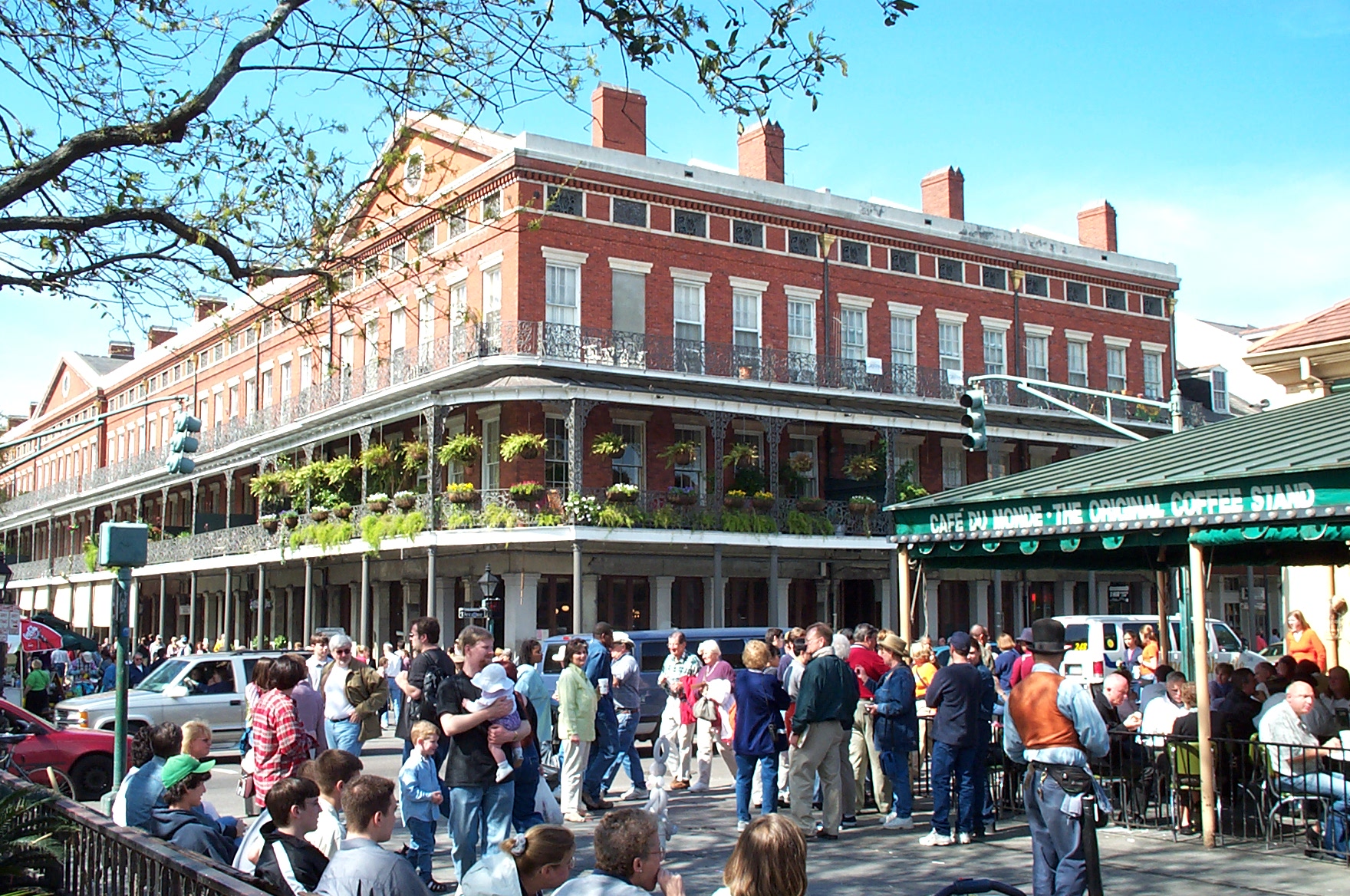
It was the late night runs to Café du Monde that cemented the correlation of scent of coffee with great memories. We made our nights in the city relatively early ones; we usually were finished with the bars by 1:00 am. Before the trek back to our hotel, we would head to the French Market for the Café du Monde coffee stand. We would order beignets and café au lait, made from the New Orleans blend of coffee and chicory. I usually take my coffee black, but the adage of “When in Rome...” was my guide.
Café du Monde at the French Market
The coffee’s scent lingers in the air around the French Market as a magical detectable perfume over the sweet, fried smell of the beignets. This lured us in for our post-Midnight snack. As I devoured my hot, sweet, puffy beignets, I mused over the hot café au lait. A good brew is thicker than tea or even premium coffees and then the milk adds a sweetness and an additionally richer texture to the coffee. The divergent flavors - bright, earthy and nutty of the coffee, the chocolaty and woodsy of the chicory – marries with the milk’s contribution of sweet, creamy and rich to make a wonderful hot beverage.
The origins of my beloved coffee start in the mid-1700 when the Dutch started to roast chicory and grind it to use as a coffee substitute. By 1806, Napoleon attempted to make France self-sufficient which included eliminating any dependence on imports, including coffee. In lieu of coffee, chicory was used as a complete substitute during this time. However, the economic system did not last more than a few years and coffee was imported again. Yet the French continued to use chicory to blend with their coffee and this practice traveled to the French-influenced city of New Orleans, where thankfully today, this blend is the normal style of coffee.
Café du Monde's flagship is located at 800 Decatur Street, New Orleans, LA. Coffee can be purchased from the on-line site and in select supermarkets.
Images, except Gold Standard of New Orleans Coffee, courtesy of Wikipedia Commons.
This is a little bit of a cheat since I’m leaving for Ireland in thirty-eight days, but I have always wished to return. Twelve years ago, I got the opportunity to visit Ireland with one of my best friends, Laura, and the trip was definitely life-defining. We traveled throughout the Republic and Northern Ireland, hitting Dublin, Cork, Dingle, Limerick, Galway, back to Dublin, Enniskillen, Belfast and again to Dublin.
A bucolic view of Ireland
While there, I wrote nine e-mails about my visit to friends and family. This was the time before blogs or smart phones. Digital cameras were gaining popularity, but still most pictures were taken on film and printed (and also scanned onto a CD at the photo processor’s.)
In one of my several attempted to design a webpage and to keep a travelogue, I posted my e-mails, including all typos, misspellings and missing words on my cuchulainn.net site. I went back to visit them to see what had impressed me about Ireland and what I wanted to share with my folks while I was still there.
Ha-penny Bridge, Dublin, Ireland.
My observations about Ireland amused me. I mention that Laura and I would stop mid-conversation and saying that the people “look so effing Irish” and that an Irish Bar in Ireland looks like any other Irish Bar in the world, including a few that I’ve seen in France and Japan. I was disillusioned crossing into Northern Ireland from the Republic, since it was more anti-climactic than crossing into Delaware from Pennsylvania; I didn’t even remember since a sign saying anything like, “Welcome to the UK.”
As for the cities, Dublin reminded me of Boston; Cork, Manayunk; and Belfast, New York but smaller and more colonial. I was thrilled to visit the Dublin’s General Post Office (GPO) to see the statue of Cuchulainn as a memorial for Easter Uprising, but I was disappointed by its small stature. I was humored by how still superstitious the Irish are, since the Y2K bug was a very big topic there. In Enniskillen, I walked around town and happened upon a Pound Store (just like a Dollar Store, except things cost a £,) it tickled me.
Belfast City Hall
One of the things that I won’t be getting to do this time in Ireland is visit Belfast or any of Northern Ireland. We simply don’t have the time to stay longer to do so. However, I did get to Belfast when I was there in 1999, where I stayed with Laura’s friend, who drove us through Catholic and Protestant Belfast. We went past the Peace Lines – walls built around Catholic sections of Belfast that look more like No Man’s Land barriers than Peace Lines. I was taken aback by the Murals, particularly one featuring the Cuchulainn statue from the GPO and a Northern Irish British solider with symbols of Ulster and the Union Jack, claiming Cuchulainn as the North’s protector, too.
The Mural in West Belfast
In my last e-mail from the island of Ireland, I stated “I will miss this little island and I will have to return.” I have missed Ireland, its people and its culture; visiting really left a mark on me. I can’t begin to explain how elated I am that I get to return.
If you are interested, feel free to read my error-ridden e-mails from Ireland in 1999.