Thursday, September 29, 2011

myPics: "On Silent Haunches"

I always think of Carl Sandburg's "Fog" when I visit San Francisco. 


Here is a picture I took last week on the fog approaching the city from the vantage point of Crissy Field.  You can see Coit Tower, Nob Hill and the Transamerica Pyramid off in the distance, waiting for the encroaching fog.

For a reference, this is how thick the impending fog was as it pours through the Golden Gate.

Thursday, September 22, 2011

myPics: Caisleán na Blarnan

Irish for Blarney Castle, Caisleán na Blarnan is the partial ruin attraction in Co. Cork. 


With some accessible rooms and battlements, this building houses the noted Blarney Stone found among the machicolations of the castle. (Machicolations are floor openings in the upper levels of a battlement, through which objects are dropped on attackers at the base of a defensive wall.) This is why prior to the safeguards at the castle, kissing the Blarney Stone was performed with real risk to life and limb, as those wanting to make the kiss were held by the ankles and dangled upside down from the height to reach the stone.

Wednesday, September 21, 2011

Not yet named food entry: Irish Stout Porters (Ireland)

I’m back from Ireland and I am pleased to report that I was able to sample my Irish Food Trinity.  I started on day two at Abrakebabra with my chips and curry and went until my second to last day to get the brown bread ice cream at Gogarty’s.  In the middle, I enjoy many pints of Guinness, Smithwick’s, Bulmers (Cider) and the odd European beer.  The majority of my drinks were one of the three well-known Irish Stout Porters – Guinness, Murphy’s and Beamish.

I lauded Guinness before leaving for Ireland and I finally got to visit the Guinness Storehouse in St. James’s Gate to learn more about the brew.  First, it is truly red.  The malted barley is roasted a deep brown to bring out the flavor through the burnt sugars.  This roasting is responsible for the deep ruby red color that Guinness actually is.  If you don’t believe, take a glassful of Guinness (or some of you will just take mine) and hold it up to the light and see that it’s a very deep red.
Getting schooled on Guinness draught  pouring
Then, I learned how to pour a legitimate pint of Guinness.  Nitrogen gas gives us the cream-like head and it takes 119.5 seconds at minimum to pour the perfect draught.  You pour the beer into a pint glass ¾ of the way full, and then wait for the Guinness surge to finish.  This tumbling of nitrogen and carbon dioxide takes a tan looking pour and settles into the start of the iconic black beer with creamy head that we all know.  After the surge has settled, you top off the pint to make the head.

The Irish stout porter tasted even more surprisingly light in my mouth than I remembered.  The mouth feel was light and airy for a liquid, not abrasive like a carbonated soft drink. In Ireland, Guinness had more sweet favors like malt, chocolate and caramel without the usual peaty, bitter aftertaste that I recall from Stateside Guinness. The more pungent flavors of molasses and burnt sugar are lacking, too.
Said Murphy's in honor of my friend, Murph
I didn’t seek out any tours of remaining 2 famous stouts’ facilities, but I’m going to assume that the creation and the pouring of the beers are similar to Guinness. Therefore in honor of my friend, Murph, I made sure that I had a Murphy’s Irish Stout, the main competitor of Guinness.  The drink has a similar mouth feel to Guinness; it was a rolling liquid with a hint of thickness.   This beer has more of a nutty flavor with a slight hint of mocha. Unlike Guinness, there is no bitter aftertaste.

Finishing out the troika of Irish Stout, I made sure that I had a Beamish in Courtney’s in Killarney. Beamish is the pride and joy of Cork. (Ironically, though, the Beamish & Crawford brewery, the originator of the beer, closed in 2009 and now Beamish is brewed at the nearby Heineken Brewery, which was previously a Murphy's Brewery.) Do not go to Ireland’s largest county and expect Guinness. Meanwhile, this beer is the lightest stout in mouth feel and taste.  While Beamish is malty, dark and chocolaty, it is not as intense as the other two brews.  The beer’s consistency still rolls yet it’s light and covers the palate rather than fill the mouth.
The Quays, a site of many Murphy's and Guinness downed
When in Cork, I will always order a Beamish! On the rest of the island, it will be a tough decision between Murphy’s and Guinness.

Thursday, September 15, 2011

myPics: From the Ring of Kerry

I wanted to post a picture of my trip so far. Somewhere on the Ring of Kelly, which trails around the Iveragh Peninsula, we pulled over to snap this picture of the visit. I can't remember where we were, but this Co. Kerry to me.

Tuesday, September 06, 2011

Wish List: Giant’s Causeway

I’m not going to the North this trip which is why I feel perfectly fine with putting Giant’s Causeway on today’s Wish List.


First, I know that my schedule is off.  Long weekends always mess up with my calendar. Though I know it’s Monday but it feels like Sunday, I never get over that it’s Tuesday and it feels like a Monday.  When Saturday comes around, I tend to think I’m late for work. This is a long introduction to say that I know I’ve scheduled Wish List on Mondays, but it’s late this week.  I’m not planning on trying to stick to my writing topics until I return from Éire.
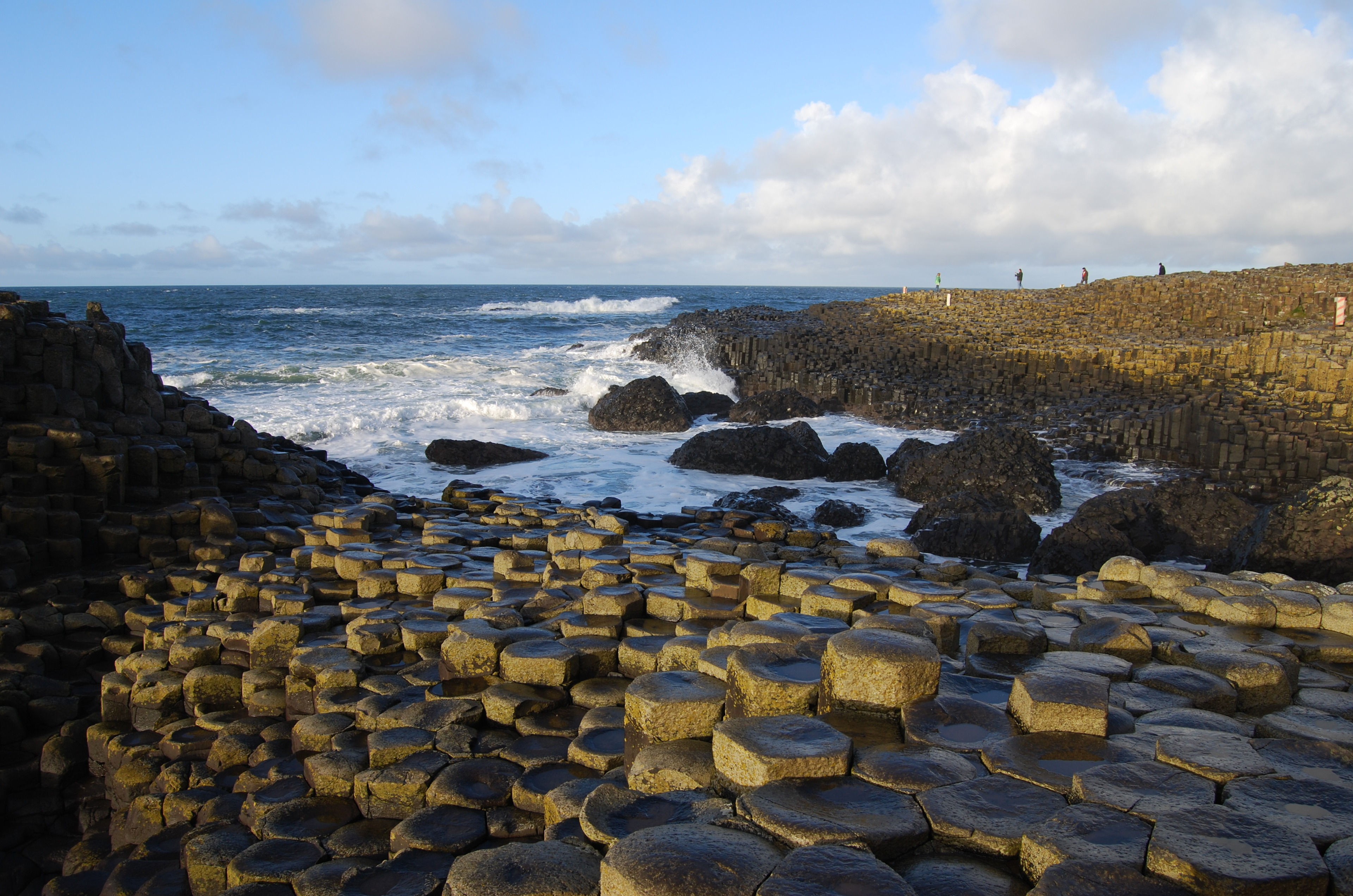
Many of the hexagonal basalt columns at Giant's Causeway
The Giant’s Causeway is an area of mostly hexagonal basalt columns from the aftermath of an ancient volcanic eruption located just northeast of Bushmills, County Antrim.  (Yes, near NI’s favorite whiskey distiller.)  This site has been declared a UNESCO World Heritage Site. 

The legend of Giant’s Causeway focuses on Fionn mac Cumhaill, (Finn MacCool) a mythical hunter-warrior of Irish mythology who also appears in Scottish and Manx myths. His tales (Fenian Cycle) are a separate series of stories from Cú Chulainn’s. (Ulster Cycle.)
Close up of the columns
The warrior, Fionn, had a Scottish counterpart named, Benandonner. The bravado between the two men set up a rivalry from hurtling insults, socks and barbs across the channel between Ireland and Scotland.  The anger between the two grew to a head after a threat from the Scottish giant that if Benadonner could get a hand on Fionn, Fionn would never be able to fight again.  Fionn was so enraged that he built the causeway within a week’s time to connect the two lands so that Benadonner, who couldn’t swim, would be able to reach Fionn and fight.

Driven by pride, Benandonner crossed over since he had something to prove.  However, Fionn was exhausted from building and needed to rest.  There are different tales of what happen next, so I’ll pick and choose pieces to finish the story.

Fionn was exhausted and fell asleep to rest before he would fight; his wife, Oonagh, helped him to trick Benandonner. Oonagh covered Fionn with a blanket to disguise him as their baby while the Scottish giant approached.  Upon arrival, Benadonner asked for Fionn. Oonagh said that he was away but would return.  Oonagh entertained the guest with tea and cakes in which she slipped some rocks.  As Benadonner ate, he broke his teeth on what he thought were miserably hard cakes.  He noticed that Oonagh’s son, upon waking, was given the same food (but without rocks) and was eating them with ease.  Curious, he approached the baby and saw his enormity. Against better judgment reached out to stoke the baby’s head.  Fionn bit Benadonner’s finger, and Benadonner realize that if this massive child could eat stone-hard cakes and violently bite a man’s finger, there was no telling how big his father would be and what he would be capable of doing in a fight.  With the fear settling in, Benadonner ran, leaving Oonagh’s hospitality and tearing up the causeway in his wake.
The Pipe Organ formation at Giant's Causeway
 In Scotland, there is a formation, Fingal’s Cave on the island of Staff which is made from the same ancient lava flow.  This time, the basalt columns construct the basis of the cave.  The isle of Ulva also shows proof of this lava which had traversed between the two land masses.  This legend matches up with the geologic history to the British Isles.

The Irish tales are very rich fables, with many different plots, characters or even competing stories – like Perrault or the Bros. Grimm say, for our faerie tales – that the Irish told to explain their world.

Next time I go to Ireland, I’m going to have to head North: Co. Sligo, Co. Donegal, Co. Derry, Co. Antrim and Belfast to enjoy the other side of the Isle.

Images are courtesy of Wikipedia

Thursday, September 01, 2011

myPics: Art through the Trees

Walking home last night, I noticed how busy campus seems.  Students are officially back and today it the first major wave of move-in, the Class of 2015 move-in. In my heighten sense, I noticed a piece of art on campus that I have overlooked.

"Black Forest," Robinson Fredenthal (American, 1940 - 2009). It's an imposing black sculpture featuring triangles to encourage the observer to view from different angles.  The multiple vantage points of the piece hope to inspire interest and lively discussion.
"Black Forest" on Penn's Campus
I did a little research on Fredenthal for this entry. He was born in Claremont, New Hampshire in 1940 and earned a Bachelor of Arts in 1963 and a Bachelor of Architecture in 1967 from Penn.  This piece is one of the artist's many studies of cubes and of what happens when he stands them on their corners, cuts through them with planes, rotates and stacks them.  I took the photo using my iPhone's HDR, High dynamic range imaging, which accentuates the different between the bright and dark zones in the picture.

Fried Eggs with Sautéed Asparagus and Andouille

I was looking for something for dinner tonight because I have a few eggs that cracked in transit from shopping. I searched "egg for di...