Last night, Piers Morgan focused some time on his show about the Hurricane Irene coverage, asking the pithy sound bite: Hurricane or Hype? The crux of this question centered on whether or not the media’s coverage and government’s reaction was too much. I made my opinion about this topic in the middle of the storm.
While news anchors are prone to sensationalism, the coverage and reactions were apropos for a storm of this magnitude. While I am one of the first people to criticize weathermen for their inaccurate predictions – which is usually about a snow storm that doesn’t cancel school the next day, I do understand that they are reporting on predictions. Meteorologists use complicated weather models to make educated guesses about the tracks of storms. By nature, to predict is to estimate or calculate in advance; there is nothing certain about it.
|
 |
| Hurricane Irene's path |
Looking back on two storms that have wove their way into the collective memory, I think that we’ve improved on our coverage. There have been lessons to learn after each storm, but there is always more to learn.
Hurricane Andrew in 1992 taught us some serious lessons about reporting. The media’s attention was on Miami,
the most overdue city for a hurricane, but the destruction was south of the Gateway to the Americas. This monster storm leveled Homestead, FL. Yet before this fact was known, reports celebrated that Miami dodged a bullet. It wasn’t until the storm had moved into the Gulf of Mexico that information about the damage in South Florida started to come to light. The media had focused on the big city in harm’s way, but neglected the actual location of landfall. This storm was the costliest Atlantic hurricane in U.S. history until 2005.
 |
| Andrew making landfall |
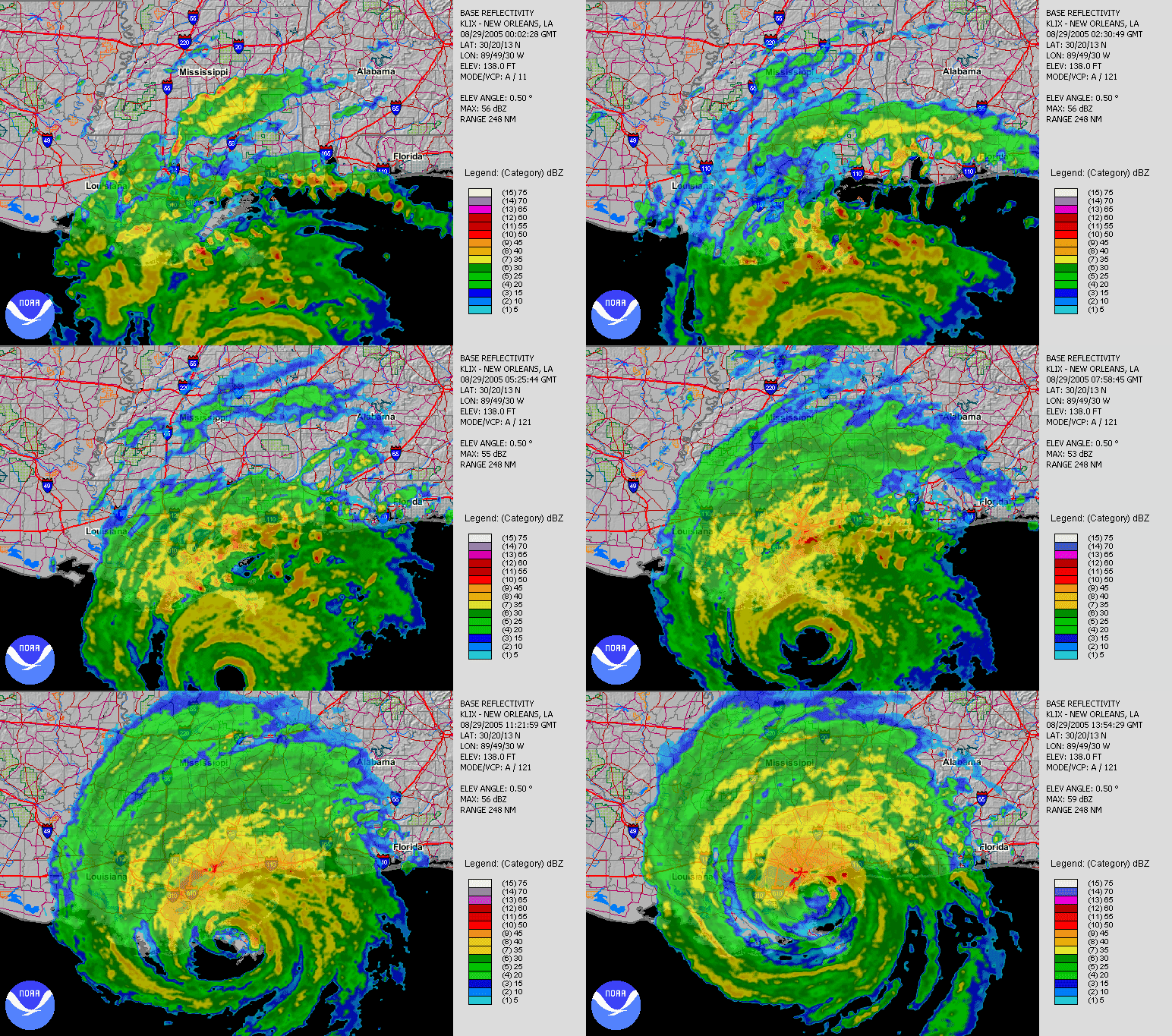
As you know, the costliest U.S. hurricane is 2005’s Hurricane Katrina. While Andrew did serve as a wakeup call, we took very long to act on it. I remember as late as early 2005 watching shows about the Hurricane preparedness of New Orleans which highlighted the vulnerable position that the Crescent City lies between the Mississippi and Lake Pontchartrain. Originally the site of Native American portages between the two bodies of water, the Big Easy rises up from below sea-level to be one of the great American cities. This time, the media was focused on the eye of this storm and not only the largest possible target city. When Karina made her third and final landfall on the Louisiana-Mississippi border, east of this great American city, there was a huge sense of relief that the storm didn’t deadhead into the city. Yet it was the wind, rain and storm surge that followed, coming from the western portions of the storm, which broke the levees and caused the cataclysmic devastation. The failure of the levees remains a huge black eye on United States Army Corps of Engineers.
Prior to Katrina that year, Hurricane Cindy hit Louisiana and caused New Orleans’ largest blackout since Hurricane Betsy in 1965 but that storm was touted to be bigger and more destructive than it was. While Katrina’s hit was impending, Mayor Nagin did order the first ever mandatory evacuation of the city. Unfortunately, many ignored it or waited until it was too late. Those who survived admit that they had become nonchalant about hurricane threats since storms had missed the city for decades.
Hurricane Katrina is a defining moment of our American history. The loss was eminence; it is the costliest U.S. hurricane. In the aftermath, people felt that the government didn’t do enough for our citizens and to this day many New Orleanians still suffer from Katrina's long lasting effects.
 |
| Katrina making its second landfall (first landfall was in Florida) |
This leads me to this past week. As Katrina serves as one of our American tragedies with over 1,800 dead, her scope was small compared to Irene’s enormous projected danger zone. There were an estimated 65 million people who were in Irene’s path this last week in the U.S. mainland alone, not including Puerto Rico, the Bahamas, Jamaica and Canada. This storm was notable, like Katrina, in making three landfalls, first around Atlantic Beach, NC, the second in New Jersey by the Little Egg Inlet and the last in Coney Island, Brooklyn, New York. This made Irene the first hurricane since Agnes in 1972 to make landfall directly in New York City.
While the storm ended up being less destructive than predicted for most of the 65 million people, our fellow country men and women in North Carolina, upstate New York and Vermont have suffered greatly. Since North Carolina took the first brunt of the storm and Irene stalled over the Pamlico Sound, the storm lost the wind punch that could have shattered New York upon its direct hit. Yet Irene was still a rainmaker and most of the East Coast was under a flood watch or warning during the storm’s lifespan. Many small towns in the New England area have been flooded off the map. The ruin left behind is unfortunately record breaking.
 |
| Irene over North Carolina |
Most of the coverage seemed to highlight New York and New Jersey during Sunday. However the storm hit North Carolina on Saturday and the coverage came in from Atlantic Beach, Nags Head and Virginia Beach then. As Irene trekked up the New York – Connecticut border, the reports followed her track.
No one could truly predict Irene’s behavior when she made her multiple landfalls. I think that stations were being responsible in reporting how bad the damage could be and demonstrating how vicious her wake was. I’m glad that our elected officials handled the situation with gravitas and mandated evacuations. I don’t fault and I support the EMS manager in New Jersey who warned those who didn’t heed the order to “take a 3x5 card, use indelible ink and write your name, Social Security Number, Date of Birthday, next of kin, way to reach them on the card. Then place the card in your left shoe, not a flip flop or a sandal, so we can identify you whenever we find your body.” Those who couldn’t leave on their own accord were offered assistant to get out of harm’s way. Those who choose to stay behind are selfish, and they make matters worse in endangering the brave men and women who are then charged with saving them when they do find themselves in trouble.
Finally, to those who think Irene was blown out of proportion, shut up. Instead, pray for the 37 victims and their families. Thank your God that you didn’t suffer in wake of the storm and pony up some relief to our follow Americans who were devastated by the Hurricane. And who knows, we may all get pummeled by Katia.
To help, visit
www.cnn.com/impact.
Images, except where noted, are courtesy of Wikipedia.


 Later in the evening, we headed to Raleigh’s First Night Celebration. The highlight for us is the Children’s Celebration with features crafts, performances and interactive activities. From the Ferris Wheel to the street food, from the giant Lite Brite Board to the circus acts on the street, the culmination of the celebration is the People's Procession. As a metaphor for the end of the year, the Children's Celebration ends and the evening entertainment begins, this passage of time from afternoon to evening, like from old year to new year, is heralded in through a fun, colorful parade for children of all ages. The NC State University Pipes & Drums leads the parade with music and rhythm from the Capitol and down Salisbury Street into the street fair as folks cheer on the appearance of Rhea, a giant puppet named after the Greek mother of the gods and designed to represent the landscape of North Carolina. The finale of the parade is the giant Acorn drop at City Plaza (for the children who can’t stay awake to usher in the New Year, and the city repeats this at midnight for those who can stay up.)