Showing posts with label Wish List. Show all posts

Monday, April 30, 2012

Wish List: The ROM

East-facing façade of the Royal Ontario Museum,
built in 1933, courtesy of Wikipedia
It’s months shy of a decade since first I visited the ROM, the Royal Ontario Museum, in Toronto. Back then, the ROM was an example of Italianate Neo-Romanesque architecture – a beautiful building commanding Bloor Street. During my stay in 2002, I had heard about the new plans for the ROM and this talk about an addition that would look like a chrysalis. The vision of something so radically incongruous coming out of an original traditional structure always piques my fancy.

Now, with my recently-expedited renewed passport, I will be heading back to YYZ for work and I have taken an extra day to get there on my dime to return to this fantastic museum, which is Canada's largest museum of world culture and natural history and one of the largest museums in North America, in general. It’s no Bata Shoe Museum, but that’s okay.

While I am excited to see the dinosaur specimens and exhibits focusing on the War of 1812’s bicentennial; it’s the Michael Lee-Chin Crystal that is drawing me to the ROM. Inspired by the ROM’s gem and mineral collection, the Crystal was quickly dubbed as such because of its crystalline shape from the original concept sketch. The architect, Daniel Libeskind, initially penned his idea on paper napkins while attending a family wedding at the ROM. This new addition is composed of five interlocking, self-supporting prisms that, per the ROM’s website, “co-exist but are not attached to the original ROM building, except for the bridges that link them.” The exterior is a fourth glass and three-fourths aluminum and the interior houses seven galleries for artifacts and Canada’s largest temporary exhibition hall. Providing openness and accessibility as well as blurring the boundaries between the public street and the private galleries, the Crystal is where both people and artifacts interact to give the museum life.

The ROM addition sketch on a paper napkin
All images, except where noted, are courtesy of the Royal Ontario Museum: Dawn of the Crystal Age.

Tuesday, April 03, 2012

Cawl

Today I’m bringing you another recipe that you can prep and cook overnight so you can refrigerate while at work to have ready for dinner.

The Welsh Leek on a £1 Silver Proof Coin
with 24k Gold Plating, courtesy of the London Coin Company.
In anticipation of a trip to Wales and Scotland via England, I have been doing my research of all things Welsh and Scottish.  We all know that I got the whisky thing down right, even dropping the "e" when talking Scotch. Yet outside of a haggis, whisky (Scotland) and leeks (Wales), I do know what else to expect. (Scotch eggs might not even be Scottish; London department store Fortnum & Mason claims to have invented them in 1738. For more of a tie in, if you go to the Fortnum & Mason site for the week of April 1, the second photo is of the Queen and the two Duchesses taken on March 1st, St. David's Day, the Welsh nation holiday; Duchess Catherine is wearing a daffodil, the Welsh flower.)

Cawl is recognized as Wales’ national dish. Originally a simple concoction of meat and vegetables, cawl was regularly served in winter months as a two-course meal. The broth would be strained off and served as a light soup then the meat and vegetables would be the main course. Today, the dish has developed into a lamb and leek soup and most common recipes included start with mutton or lamb and leeks with the addition of potatoes, rutabagas, carrots and other seasonal vegetables.  All the pages about Welsh cuisine and food inform me that cawl should be started the day before so that any fat can be skimmed off and all the flavors can blend – perfect for the slow cooker.

Cawl, modified from the following cawl for slow cooker recipes: squidoo.com, bbc.co.uk - Mid Wales page and allrecipes.co.uk

Ingredients:
The finely chopped reserved parsley and leek.
  • 2-3 lbs. lamb, shoulder (If lamb is difficult to get hold of, stewing beef is a good substitute. Sometimes I do half and half)
  • 6 small potatoes, quartered (For durability in the slow cooker, I use small new red potatoes or Yukon golds)
  • 3 leeks, washed and sliced, reserving 1 leek for serving
  • 2 medium carrots, peeled and sliced
  • 1 large onion, quartered and sliced
  • 1 medium parsnip, peeled and sliced
  • 1 small rutabaga or 2 small white turnips, peeled and cubed
  • ½ small head of cabbage, shredded
  • 2 Tbsp parsley, chopped, reserving 1 Tbsp for serving
  • 1 tsp salt, or to taste
  • 8-10 peppercorns, or to taste
  • 10 cps water
Cawl, on the dinner table (and my
cluttered kitchen in the background. Shh!)
Directions:
  1. Trim the fat from the meat as much as you can, and cube into ½ inch sized pieces.
  2. Add the remaining ingredients but the reserved leek and parsley and cover with cold water.
  3. Cook on Low for 8 hours.
  4. Allow to cool (preferably 8 hours) and skim off all the fat.
  5. Return to cook on High for 30 minutes or until at a good serving temperature
  6. Finely chop the reserved leek and parsley
  7. Top the cawl with the chopped leek and parsley and serve with bread.
After making this, I can recommend that you're going to need more salt than you think.  So I salted my cawl after cooking and after chilling and reheating.  I was surprised how the salt disappeared.  Also, when I revisit this, I might consider using some vegetable broth or stock to replace some of the water.

Lastly, if you are going to serve cawl the traditional two-course manner, I would make this suggestion. After removing the lamb and vegetable, add the reserved parsley and leeks to the broth.  This will add more texture to the soup when you serve it as the first course.

Monday, March 19, 2012

Wish List: Chasing the 8

In my family, there’s a running joke that there’s a transportation gene in the clan at large. Most of us who are directly related to the Ryan blood line have some fascination with modes of travel. Some love planes. Some love trains. One of us admits that boats are his passion. Family gatherings with my cousins always end up talking about trips to Shanghai, Rio and Paris as well as to San Francisco, Rochester and Providence. We type e-mails in airport codes, knowing where MSY, EZE and YUL are. We are familiar with AASHTO (American Association of State Highway and Transportation Officials) and the Interstate System, and know how to navigate three-digit spurs as well as three-digit US routes. Getting there is definitely half the fun for us.
Yuma Quartermaster Depot State Historic Park, formerly Yuma Crossing State Historic Park, in the Yuma Crossing National Heritage Area
For me, I am energized by travel. I like taking a new road and being on an old familiar one. I am excited to get to the terminus of a route. When there’s a State Route 1, I have to know where it goes. The 101 is on my self-proclaimed songline.
Cactus in Arizona, near the junction of the 8 and the 10
After this introduction, you should understand my thought behind “Chasing the 8.” I would like to vacation and drive across Interstate 8 from Casa Grande, AZ to San Diego, CA. The 348 ¼ mile journey goes through the southern extremes of Arizona and California and the route itself has some of its own extremes, including the closest interstate to parallel the Mexican border (less than ½ mile), one of the widest medians of an Interstate (over 1.5 miles) and lowest above-ground elevation of an interstate at (52 feet below sea level)*. There are only 3 single digit Interstates in the system (the signed Hawai’i series and the unsigned Alaska series don’t count) and I’ve been on parts of the 5 (1,381 ¼ miles) and all but about 8½ miles of Interstate 4 (132 ¼ miles). I want one that I can conquer. (I wasn’t driving on Interstate 4 or else I would have driven into Tampa to check that off my list.)
Mission Basilica San Diego de Alcalá, location along the 8
Not only will I conquer my own interstate, I will fill a missing piece in my US map: the link between sea to shining sea. I have driven out to Joshua Tree National Monument in California from LA as well as taken the 8 to its end in San Diego form Chargers Stadium to Sunset Cliffs Boulevard onto Nimitz Boulevard. I had trek out from Phoenix, taking the Hohokam Expressway to the 10 and onward to Dallas via Las Cruces, White Sands, Alamogordo and Roswell, NM; and Odessa, Midland and Abilene, TX. Separately, I’ve journeyed from Atlanta City to Philadelphia and Philadelphia to San Antonio – meeting my two routes the junction of Interstates 20 and 35E. I have pieced together a cross country route, but yet I’m missing my own Golden Spike.
A map of US counties (click to expand): pink and purple represent my current work territories & purple and blue represent counties I've actually visited - the image comes from Marty O'Brien's Interactive Counties Map
I’ve been to the 8’s termini but never driven across. That makes my driving trip through Phoenix and Casa Grande, Sonoran Desert National Monument and Yuma, AZ; and El Centro, Cleveland National Forest, and El Cajon, CA to the end doubly enticing to me. I’ll have connected an interstate and have connected an transcontinental trip.

I know don’t know what I’ll actually see, but I’ll buy a lot of water for the voyage.

* The lowest point on the Interstate System is within the Fort McHenry Tunnel, Baltimore, Maryland, on I-95 at 107 feet below sea level.

Monday, December 12, 2011

Wish List: City Island

Usually when I’m in an airport first thing in the morning on Monday, it’s because I’m heading out early for a day trip somewhere. Today, however, I’m still in transit, connecting from a red eye out of Southern California to Philadelphia. Thinking about my recent visit to the LA metro area, I want to go somewhere where I don’t have to drive at all.

The traffic in all throughout the region was hellish. Even my beloved US 101 Songline was more like a parking lot than a freeway. It reinforces why I love cities with great public transportation.
City Island Nautical Museum, image courtesy of Wikipedia
When I turn the phrase “city with great public transportation” I immediately think of New York, our most populated city in the US. While the traffic can be as nightmarish as Los Angeles (have you ever tried to get into the city through the Lincoln Tunnel at 4:30 in the afternoon?) the subway and bus system as well as the taxis of NYC eliminate my stress of needing to drive.

New York is a megapolis – a super city. However just off to the side of this almost unmanageable mass of humanity and skyscrapers lies a relative peaceful, New-England-like oasis: City Island. In Long Island Sound, this charming island with only one way in and out redefines living in the city.
Sea Shore Restaurant & Marina

If you have heard of City Island, it may because of the movie starring Andy García, Julianna Margulies and Alan Arkin. However my love affair started when I had noticed it on a map many years ago. It seems to be in my DNA to appreciate and gravitate toward all of the quirky or superlative places on the earth: the most Western point in Ireland, the most Southern point in California, the most unlike New York City in New York. This simply named island stood out to me and I have been curious about it since.

About 2 years ago, I had seen an article on one of the travel sites that I follow about the charm of New England without leaving New York. When I finally read the name of the location, I was excited to see there were others who wanted to explore the off-the-beaten-path places in the word and that someone penned an article about the spot. City Island isn’t a tourist destination. It’s nowhere near as densely population as Manhattan and it’s sparse with famous attractions. There was only one place for lodging on the island, Le Refuge Inn Bed and Breakfast, which, according to latest google search, is closed.
A house on City Island
City Island provides a slice of life that’s more in tune with the rest of America than NYC; City Island Avenue serves as the island’s Main Street. While the subway doesn’t go to City Island, a bus does. However, bus schedule is limited since the island is a residential area of the city and not a destination like Ellis Island. For me, though, that’s the adventure – just being reliant on public transportation and exploring an area on foot makes the island alluring. It’s like exploring Astoria, Park Slope or Washington Heights for the first time.

It’s a wish of mine to get there next year, and I hope to share my visit with you. However, there is a certain irony that, in the getaway destination where I want to go, most of the residents use and need cars to get along. Yet this is the place I think when the traffic in LA got to me and I needed a place to get away from the automobile.

Images, excepted where noted, are courtesy of Nabe Wise.

Monday, December 05, 2011

Wish List: What to do in SoCal?


I’ll be traveling to Southern California this weekend for work. Since I have a red eye home, I hope to be able to go to Got Kosher on Sunday and get some more of the pretzel challah that didn’t survive the trip to San Diego last time. Yet, I still haven’t decided either I’ll stay in LA or Anaheim (I have reservations at hotels in both cities.)

The majority of time working will be in Anaheim and to get an affordable flight, I’m taking United/Continental in and out of John Wayne Airport. The Airport is an hour from the LA hotel, in good traffic. The event, a reception and game, is at the Honda Center, but the tickets for the game are up in Westwood. Once I am finished with my responsibilities, will the convenience of being close to the work event be outweighed by the ease of being close to downtown LA?
Gamble House in Pasadena, CA
So I googled “LA travel blog” to help me decide. I found The Los Angeles Consortium for Online Travel on Christopher Elliott's The 11 best new travel blogs of 2011. Christopher calls this site “easily the best new regional travel blogs to come along in a long time. It’s from a consortium of well-known LA area travel writers, including Jennifer Miner. You can tell that these folks love LA!”

I jumped into reading some of the entries and read Noah Albert’s entry about Art Deco Buildings in Los Angeles. From the 20’s to the 40’s the population of Los Angeles tripled and to match this growth in population new buildings were erected in the Art Deco style. Albert continues his entry focusing on two specific Art Deco structures, the Eastern Columbia and The Wiltern. these are two places that are his favorites, and one of the reason why is “when the light is right, the turquoise terra cotta covering both these structures looks just like blue-green magic.”
The Sunset Tower, West Hollywood, CA
Ah, architecture! The LA area is known for its art deco style, as well as its earlier arts and crafts movement, which is a personal favorite. I will take in the wonders. I think I’ve just decided that I’ll stay in LA.

Hopefully, I can sneak a peek and head out to the Gamble House in Pasadena, California on Friday. This outstanding example of American Arts and Crafts style architecture is also a favorite location of my dear friend, Rosie. Designed by Charles and Henry Greene in 1908 for David and Mary Gamble of the Procter & Gamble Company, the house is a National Historic Landmark.
The Edward Alexander Kelley Hackett House, Los Angeles, CA.

Inspired by Hollywood and Albert’s entry, I think that I’ll go check out the Sunset Tower. This hotel, is which has host many an Oscar and Golden Globes party, is located on the Sunset Strip. Architect Leland A. Bryant designed the building in 1929 and it opened in 1931. Also on the National Registry, the Sunset Tower is considered one of the finest examples of Art Deco architecture in the Los Angeles area.

Also in my searches, I found the Edward Alexander Kelley Hackett House is a historic Craftsman-style house in the Pico-Union neighborhood of Los Angeles, California. Built in 1901, the house is known for its well-preserved Craftsman architecture. After viewing the house, I can stay in the Pico-Union area, a Salvadoran and Guatemalan immigrant community, and get something tasty for lunch.

Any other suggestions for great architecture in Los Angeles?

Images courtesy of Wikipedia.

Monday, November 28, 2011

Wish List: Fort Lauderdale

My hotel chain of choice is Starwood and I am a member of the Starwood Preferred Guest (SPG) program. Earlier this year, SPG ran the SPG Getaway Free promotion.  It entailed earning one free Resort Night Award for every three eligible stays at over 1,000 hotels across all their brands from May 1 through July 31.

During that time, I stayed a total of 8 nights – split between work and leisure – at the following hotels: Aloft Houston by the Galleria; Sheraton Syracuse University Hotel; Sheraton Reston Hotel; Four Points by Sheraton San Diego; Sheraton Mission Valley San Diego and Palace Hotel, San Francisco (one of my favorites!) These six stays earned me two award nights at over 200 of Starwood's resorts; I should have squeezed a night in a Philly Starwood to get 3 nights!
Sheraton Fort Lauderdale Beach Hotel, beach view, image courtesy of Starwood
The West Coast and Southwest choices were out of the question since the airfare would be prohibitively high. The majority of the East Coast choices were in charming, secluded locations – ideal for a resort, but not for an urban fellow like me.  This left either Virginia or Florida as my viable options.  I was going to cash in the reward for two nights at Virginia Beach during my visit to Hampton Roads for Steve’s retirement ceremony, but he needed Bonnie and me to stay at his house to help with logistics.  So I didn't have to use my nights in Virginia.  Of the Florida locations, Miami and Fort Lauderdale seemed to be the most carfree positive.  I called the Miami resorts first and they had no availability, but the Sheraton Fort Lauderdale Beach Hotel could accommodate me. The only weekend that I had free was December 16-18 and there was a slot in the hotel then, so I booked. 

Then I bit the bullet to search for airfare and found a surprisingly reasonable scheduled flight to and from Fort Lauderdale for $191.40.  I snatched it up without any hesitation since it was non-stop on US Airways. I will favor the Star Alliance for my status. Resort: booked, flight: ticketed; now, I’m vacationing for a weekend in the sun the weekend before Christmas. 
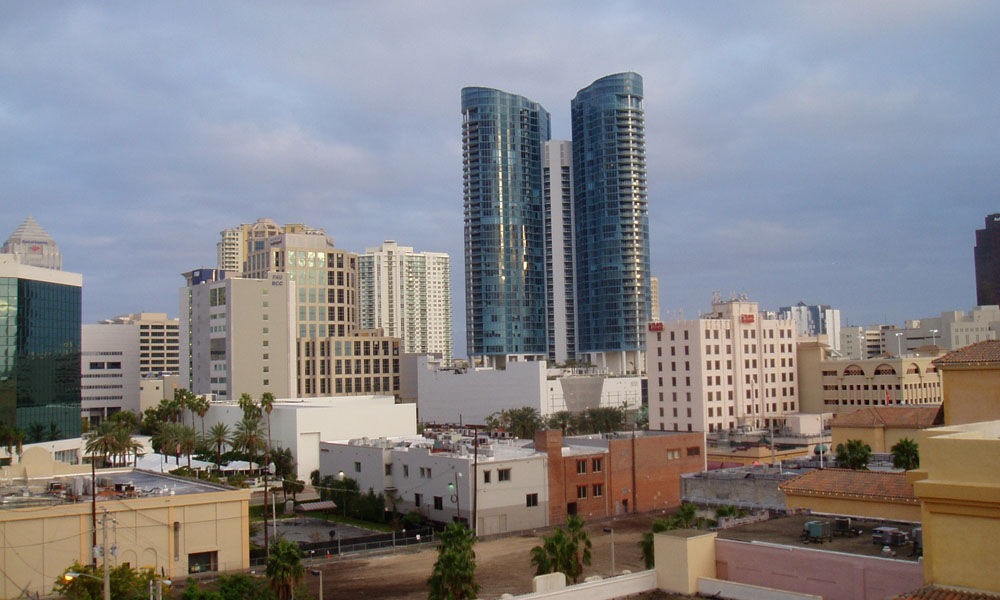
Fort Lauderdale skyline, image courtesy Wikipedia
I have only been in Fort Lauderdale briefly in 2003 and it was just a brief skirting of the city.  I had lunch at a restaurant on S. Atlantic Avenue and I drove past some of the canals.  It reminded me of Venice Beach in Los Angeles.  However that’s all I really remember; don’t have a blank slate but it’s enough of a palimpsest that I can put new experiences down and they will be my only memories of the town. 

I’m must reiterate – I'm excited to be in Florida again in the beginning of the wintry season.  I was in Orlando in December 2009 and it was a treat to be in warm weather in a month that I’m usually bundled up in.  Also being at Disney probably helped keep the energy up, but there was something deviously exciting about Christmas decorations being staged in a climate of 70 degree weather – actually, like being in Abu Dhabi and Dubai in December. It’s like cheating Death, this cheating Cold. 
Stranahan House, image courtesy Stranahan House via facebook
Obviously, I will have access to the beach since I’ll be staying the Sheraton Fort Lauderdale Beach Hotel and I can imagine a few hours of solace in the sun and with the sand between my toes.  For energy, I can head to S. Atlantic Avenue and Las Olas Boulevard to take in the boutiques, restaurants and people-watching. For attractions, the Stranahan House, the oldest building in the city and county, comes with high marks and there’s always Hugh Taylor Birch State Park with the possibilities of biking, inline skating, kayaking, canoeing and segway tours, as well as taking a good old fashioned hike

The food in Fort Lauderdale sounds inviting; the dining experience has been described as casual chic.  Being so close to Miami and the Caribbean, I am confident the Cuban cuisine will be out of this world and that I will find treasures like Puertoriqueño, Jamaican and Indian restaurants. I am going to yelp to find an intimate café or an al fresco waterfront eatery where I can enjoy phenomenal dish crafted with seafood straight from the sea and local fruits and vegetables. 
Christmas lights in South Flordia, image courtesy of Fort Lauderdale Christmas Lights
I'm going to make this trip my brief respite during the hectic time that is the holiday season. From work to family, my time between now and New Year's Eve is full and devoted to others.  So a few days of R&R will be good for my soul, so I can jump into the wonderful chaos that the Holidays bring.

Monday, November 14, 2011

Wish List: Saint Pierre and Miquelon

Just over 10 miles off the coast of Newfoundland lies the last slice of Nouvelle-France, the former French colony in North America. The French jurisdiction which once spanned over 2 million square miles has been reduced to just over 90 in the form of the collectivité territoriale (territorial collectivity) of Saint-Pierre-et-Miquelon. The archipelago of eight islands, located in the entrance of Fortune Bay, strongly celebrates its Basque, Breton and Norman roots as a sea fairing land.
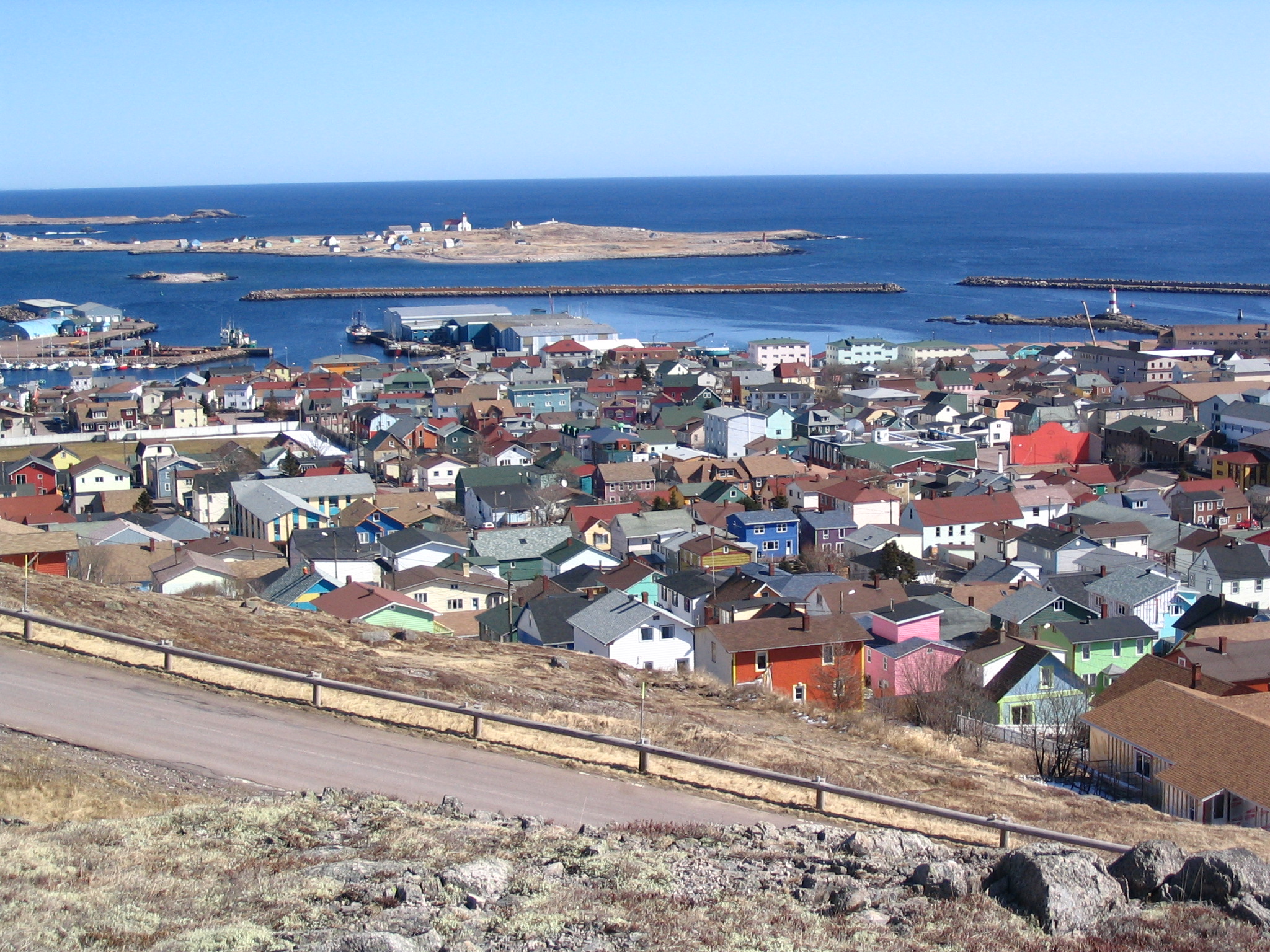
A view of Saint-Pierre, the capital of Saint Pierre and Miquelon
The inhabitants of Saint Pierre and Miquelon are French. They have French citizenship and vote in national elections. The collectivity is represented in France’s National Assembly with both a senator and a deputy (similar in role to a US Representative). The euro is the currency. Though over 4,000 miles from the closest continental French city, Saint Pierre and Miquelon is France's oldest remaining overseas territory as well as its closest and smallest territory. In short, it is France.
The Cathedral in Saint-Pierre
The Saint-Pierrais and Miquelonnais total around 7,000, most of who were born in the collectivity but a rising number have come from continental France. The rich culture of the people helps them to live, survive and thrive in this barren land. The climate is very damp and windy making winters are harsh and long and the spring foggy and cool. However, late summer and early fall are sunny. Due to the conditions, the growing season is challenging but they do produce some vegetables, poultry, cattle, sheep, pigs and, of course, fish. The local cuisine is heavily based on seafood including lobster, snow crab, cod, mussels and many cod-based dishes, as well as some of the hearty flora like cloudberries and blueberries. Liquors based on or flavored with cloudberries and blueberries flourish.
Les Drapeaux: the flag of France (above) and the unofficial local flag featuring Cartier's ship, Grande Hermine, and cantons (top to bottom) representing the Basques, Bretons and Normans.
Getting there is pricey, but you do have your choice of flying or ferrying. There isn’t a hotel chain to be found on the archipelago, but there are clusters of houses painted in a riot of colors, nestled in which are cozy bed and breakfasts and hôtels. It’s a far-fling destination not too bothered by the urban conveniences. However, that, for me is where all the charm lies. That as the enticing fact that France is only 800 miles North East of Boston. (Or slightly under 1,100 miles from Philadelphia – France is closer to us then New Orleans!)

Images are © Marc A. Cormier – www.st-pierre-et-miquelon.com and are available through flickr. I also encourage you to become a fan of Saint-Pierre-et-Miquelon on facebook. 

Monday, October 10, 2011

Wish List: Hikes

I'm in the airport this morning, waiting on my flight with a crew delay. So I thought that I would try to jot a wish list entry via my mobile.

Returning from Ireland, I watched a travel show as part of Continental's in flight entertainment. The show was about hiking the Larapinta Trail in Northern Territory, Australia. The trek was amazing; starting outside of Alice Springs, the trail heads westward following the Larapinta River. The name comes from the local aboriginal language for salty river. At one point along the hike, the host and her guide sampled the river water to show thai it was indeed salty. The location of the trail was based on John McDouall Stuart's travels across Australia from the south to the north. Even today, the trail demonstrates the hardships that Stuart came up against while trying to open up the interior of the continent.

While I'm not ready to go off and hike that particular trail right now, I'd like to add more hikes into my weekends. There are many pages on line of local easy trails to hike along. There are a few in Delaware that interest me and I'll probable end up doing one before the end of fall. Then I can work my way up to Yosemite and Australia.

Any good suggestions for your favorite trails?

Some links for additional information:

Larapinta Trail: http://www.australia.com/itineraries/nt_larapinta_trail.aspx
Sample of trails in DE: http://www.destateparks.com/activities/Trails/locations/fort-dupont/index.asp
John McDouall Stuart: http://en.m.wikipedia.org/wiki/John_McDouall_Stuart

Image is courtesy of http://worldislandparadise.com/backpacker-zone/standley-chasm-australia via my iPhone

Monday, October 03, 2011

Wish List: Italy

I have a friend who lives in the Middle East and I was fortunate enough to get to visit her last year.  While I was able to make the trek there, not all of my friends have that flexibility.  It’s a long time to get there and return – almost 21 hours there and almost a full day back via Frankfurt.  It’s a culture shock too. For those reasons, I’ve been working on a plan to get us to get together somewhere in Europe so that others can join up for the vacation.
Il Ponte dei Sospiri (The Bridge of Sighs) in Venice, so named since my Iberian choices were overruled
Spain and Portugal lie roughly along the half way point between the nearly 7,000 miles between Philadelphia and Abu Dhabi.  So I propose that, looking into ideas for Lisbon or Barcelona. However, I’m overridden and my posse calls for Italy.
Il Torre di Pisa - in Italian, it's just a tower
Outside of the distance being a little askew (about 2,700 miles from AUH and 4,300 from PHL to Rome), Italy could be the ideal location.  I just don’t know what we’ll do.  Do we stay in one city, like Rome, and see the sights? Do we rent a villa in Italy, like a co-worker’s family did? Do we travel across the countryside from town to town to see a bit of it all?
La Basilica Papale di San Pietro (St. Peter's Basilica), visible from Italy but is in the Holy See
I don’t have a clue as to what we’d like to do.  However the plan is to go in mid- to late April. (Right now, that seems to be the best time for our schedules.)  Yet, I have a lot of research to do.  I need to learn Italian history.  I need to be familiar with the different styles of cuisine.  I must bone up on my Italian wines, since I’m really a new world grape fan.  One thing is for sure, we will have a blast when we get to go.

Any ideas or tips?  Feel free to tweet me or post your suggestions on blogger or facebook.

Images are courtesy of TripAdvisor.

Tuesday, September 06, 2011

Wish List: Giant’s Causeway

I’m not going to the North this trip which is why I feel perfectly fine with putting Giant’s Causeway on today’s Wish List.


First, I know that my schedule is off.  Long weekends always mess up with my calendar. Though I know it’s Monday but it feels like Sunday, I never get over that it’s Tuesday and it feels like a Monday.  When Saturday comes around, I tend to think I’m late for work. This is a long introduction to say that I know I’ve scheduled Wish List on Mondays, but it’s late this week.  I’m not planning on trying to stick to my writing topics until I return from Éire.
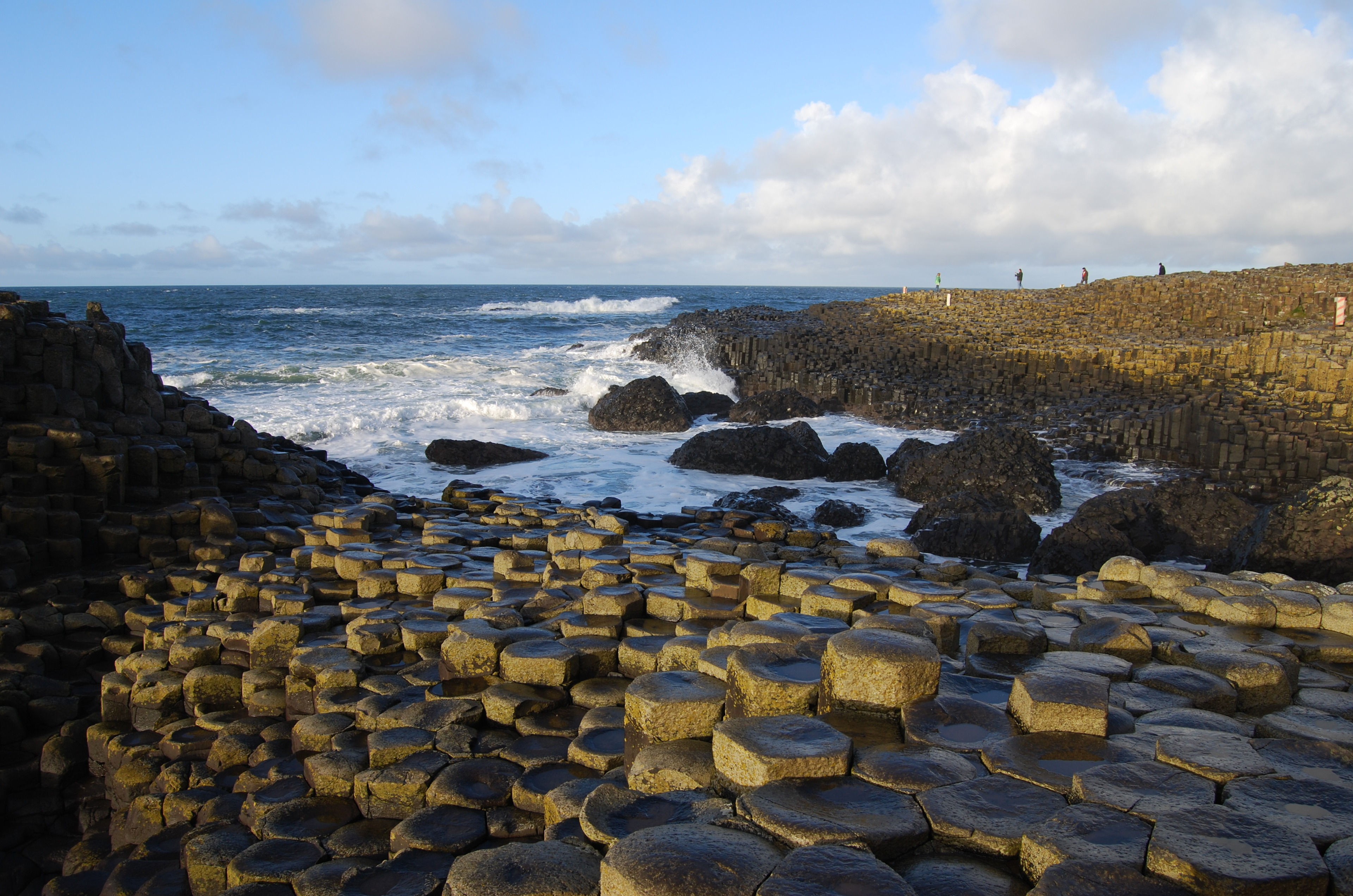
Many of the hexagonal basalt columns at Giant's Causeway
The Giant’s Causeway is an area of mostly hexagonal basalt columns from the aftermath of an ancient volcanic eruption located just northeast of Bushmills, County Antrim.  (Yes, near NI’s favorite whiskey distiller.)  This site has been declared a UNESCO World Heritage Site. 

The legend of Giant’s Causeway focuses on Fionn mac Cumhaill, (Finn MacCool) a mythical hunter-warrior of Irish mythology who also appears in Scottish and Manx myths. His tales (Fenian Cycle) are a separate series of stories from Cú Chulainn’s. (Ulster Cycle.)
Close up of the columns
The warrior, Fionn, had a Scottish counterpart named, Benandonner. The bravado between the two men set up a rivalry from hurtling insults, socks and barbs across the channel between Ireland and Scotland.  The anger between the two grew to a head after a threat from the Scottish giant that if Benadonner could get a hand on Fionn, Fionn would never be able to fight again.  Fionn was so enraged that he built the causeway within a week’s time to connect the two lands so that Benadonner, who couldn’t swim, would be able to reach Fionn and fight.

Driven by pride, Benandonner crossed over since he had something to prove.  However, Fionn was exhausted from building and needed to rest.  There are different tales of what happen next, so I’ll pick and choose pieces to finish the story.

Fionn was exhausted and fell asleep to rest before he would fight; his wife, Oonagh, helped him to trick Benandonner. Oonagh covered Fionn with a blanket to disguise him as their baby while the Scottish giant approached.  Upon arrival, Benadonner asked for Fionn. Oonagh said that he was away but would return.  Oonagh entertained the guest with tea and cakes in which she slipped some rocks.  As Benadonner ate, he broke his teeth on what he thought were miserably hard cakes.  He noticed that Oonagh’s son, upon waking, was given the same food (but without rocks) and was eating them with ease.  Curious, he approached the baby and saw his enormity. Against better judgment reached out to stoke the baby’s head.  Fionn bit Benadonner’s finger, and Benadonner realize that if this massive child could eat stone-hard cakes and violently bite a man’s finger, there was no telling how big his father would be and what he would be capable of doing in a fight.  With the fear settling in, Benadonner ran, leaving Oonagh’s hospitality and tearing up the causeway in his wake.
The Pipe Organ formation at Giant's Causeway
 In Scotland, there is a formation, Fingal’s Cave on the island of Staff which is made from the same ancient lava flow.  This time, the basalt columns construct the basis of the cave.  The isle of Ulva also shows proof of this lava which had traversed between the two land masses.  This legend matches up with the geologic history to the British Isles.

The Irish tales are very rich fables, with many different plots, characters or even competing stories – like Perrault or the Bros. Grimm say, for our faerie tales – that the Irish told to explain their world.

Next time I go to Ireland, I’m going to have to head North: Co. Sligo, Co. Donegal, Co. Derry, Co. Antrim and Belfast to enjoy the other side of the Isle.

Images are courtesy of Wikipedia

Monday, August 29, 2011

Wish List: Where the Streets Have No Name


After the waterlogged weekend that we had on the East Coast, I’d like to take a trip to the desert.  Seeing the Schuylkill flooded carrying debris and speeding out to the Delaware made me long for someplace dry and arid. For me one of the more famous and accessible desert is the two-desert Joshua Tree National Park.
An eponymous Joshua Tree
I’ve been to Joshua Tree in the winter of 2006.  It was an ambitious day trip that I took with my friend, Denise.  I had a red eye flight to take back to Philadelphia so we left early in the morning to make the 2 ½ hour trek out to Twentynine Pines. 
A rock formation along Park Boulevard
Clichédly, we queued up the U2 as we got onto California Route 62 and followed the sign to the Park. The entrances from 62 put you into the Mojave Desert, the habitat of the Joshua Tree. The name sake of the park was named by Mormon settlers because the shape that reminded them of a Biblical story of Joshua praying with his hand up in the air.

Ecologically, this park is unique for the meeting of the two deserts.  We entered the park through the Mojave Desert, which is generally the higher, drier, and slightly cooler of the two.  The landscape features bare rock hills peppered with loose boulders and sparsely vegetated flatland.  To our east is the other desert – the Colorado Desert, part of the larger Sonoran Desert, which features scrub and cactus.  
View from Ryan Mountain
The park offers a lot to see.  In our foray, we drove through the Mojave, taking in the vast land and pointing out many of the Joshua Trees. We spied down several of the trails that intersected the main roads, but we knew that our time was short.  We headed to climb Ryan Mountain and catch a glimpse of the Colorado Desert.  In the distance, there looked a like a noticeable different between the flora around us and what was off in the east.  However, time was short and I would need to return to Los Angeles, get my bags and return the rental car before my flight.  We descended back to the car and I knew that I would plan to return
Another Joshua Tree with San Gorgonio Mountain, Southern California’s highest peak, in the background
From the NPS site, short visits of a ½ a day or less should involve the main park roads with many pullouts for wayside exhibits to learn more about Joshua Tree. On a clear day, the NPS suggests the Keys View which vista looks beyond the Salton Sea to Mexico.  For a full day, there is time to discover the Park on foot, either on one of the guided tours or on a solitary backcountry hike. Also the park has nine campgrounds for an over-night visit and for the most adventuresome, backcountry camping is permitted.  For me, my ideal visit would be a day in park from opening to close and a comfortable night in Palm Springs.

Images are courtesy of Trip Advisor

Monday, August 22, 2011

Wish List: Ottawa, ON

There are so many places in Canada that I’d like to see.  Having only been to Toronto, Montréal, Vancouver and Calgary, for example, are on my list.  Yet, I’d like to visit the capital next.

Ottawa is in nestled in the Ottawa River Valley in eastern Southern Ontario, bordering on Québec.  This location has made the National Capital Region of Ottawa and Gatineau a bilingual area with a diverse population. Home to the National Government, the city is a mixture of formalistic and functional architecture with a good helping of Romantic and Picturesque styles, too.
Central Block, Parliament Hill

Like our capital, Washington, DC, history is rich in this planned city that Queen Victoria chose as the capital for the Province of Canada (comprised of parts of modern day Ontario and Quebec) on December 31, 1857.  The city is the site of the northern terminus of the Rideau Canal, the oldest continuously operated canal system in North America and a UNESCO World Heritage Site. The canal was opened in 1832 as a precaution in case of additional war with the United States.

After the War of 1812, British forces learned that the US has planned to invade the confusingly named colony of Upper Canada* via the St. Lawrence.  The British built the canal to keep commerce and communications open between Montréal and the British naval base in Kingston, ON.  Today, the Canal is also famous as being one of the largest fresh water skating rinks in the winter.
The Canadian Museum of Civilization
As a Commonwealth Nation, they honour (wink) the British monarch as their sovereign. In June 1959 Canada accepted ten heraldic statues, The Queen's Beasts, that Ministry of Works commissioned for Queen Elizabeth II to depict her genealogy for her conoration.  Being cast in plaster, the statues could not left in the open air and they were shipped between Hampton Court Palace, Windsor Castle and, finally, storage.  The British Government decided to offer them to the Commonwealth Governments and Canada, being the senior nation, was offered them first. The beasts now reside at the Canadian Museum of Civilization in Gatineau.  I don’t know if they display them or not, but I would love to visit for a public showing of these statues.  There are replicas of The Queen's Beasts on display at Kew Gardens, if I can’t see the originals in Canada.
The Queen's Beast - The Unicorn of Scotland, courtesy of Call to Arms...
Beyond the Queen’s Beasts, the Canadian Museum of Civilization serves to collect, study, preserve, and present material objects that illuminate the human history of Canada and the cultural diversity of its people. The building, reminiscent of the Smithsonian’s National Museum of the American Indian in design and architecture,is Canada’s most popular and most-visited museum.

Across the river from the Museum stands Parliament Hill, where Gothic revival buildings, including the commanding Centre Block, serve as the home of the Parliament of Canada and the center of Canadian politics. Though Ottawa is the capital for the Confederation, Pierre Trudeau worked to increase the number of more federal workers based in the Quebec side of National Capital Region. To the end, the Central tower of the Terrasses de la Chaudière is now the area’s tallest building.
On the Rideau Canal
In writing this blog entry, I realize that there are many parallels between Washington, DC, and Ottawa, including that the largest buildings are outside of the city proper.  They share in being deliberately established between the boundary of two different demographic types, (i.e. the more agricultural south and the more Industrial north for the US and the Anglophonic Upper Canada and Francophone Lower Canada).  As I love Washington for its history and its cache of American identity, I know that I will be charmed by Ottawa’s share of Canadiana.

Images, except where noted, are courtesy of Trip Advisor.

* Upper Canada was the southern portion of Ontario, while Lower Canada was southern portion of Quebec and region of Labrador. Therefore Upper Canada is South-southeast of Lower Canada. The naming convention came from the direction of the Saint Lawrence, as Upper Canada was further along the waters of the river. In 1841, these two colonies became the Province of Canada.

Monday, August 15, 2011

Wish List: Before They’re Gone

I subscribe to several travel e-mail magazines, including Budget Travel. I enjoy their articles and I get the newsletter about twice a week. This past Thursday, I noticed a link in the newsletter, "10 Natural Wonders to See Before They Disappear," and read along in wonder. The article lists natural wonders which are threatened with non-existence within the century and includes suggestions for tour operator at each destination to take advantage of the amazing features of each destination.

Surprisingly, I have been to one of the locations on the list, the Dead Sea. When I was a freshman at Penn, I had the opportunity to travel to Israel in 1992. During my trip with the Penn Glee Club, we spent a day in Ein Gedi and played in the therapeutic waters of the Dead Sea. I never dreamed to get to the highest spot on earth, but I have made it to the lowest. The group took the prerequisite pictures of us floating, reading newspapers and magazines as if in a recliner. I was unfortunate and got the salt water in my eyes and it burned something awful. The water was salty that my vision clouded and I couldn’t see through the white haze. I carried on to get some of my peers to escort me to the public showers in order to rinse my eyes out. After ten minutes, I was able see and go back and enjoy myself. And none too soon, in last forty years, the Dead Sea has lost a third of its area and sunk about 80 feet. The water has been diverted from its only source – the Jordan River – to quench the thirsts of Israel, Jordan and Syria and this need will continue stress the endorheic lake.
The Dead Sea
Having visited the Australia’s Great Barrier Reef and been amazed with the multitude of marine life there, I want to go and see the world’s second largest reef system. The Mesoamerican Barrier Reef System stretches about 600 miles from Mexico to Honduras and runs through Belize as the country’s famous marine ecosystem. In a addition to this amazing phenomenon, Belize is the only Central American country with English as the official language which makes travel simpler for someone living in the Anglosphere.
Great Blue Hole
The Belize Barrier Reef is endangered due to coral bleaching, the whitening of corals due to the stress-induced loss of their symbiotic organisms. The stressors are but not limited to pollution, global warming, storms or bacterial fluctuations. Once stressed, the organisms can take weeks to months to return to the coral during which time the coral remain susceptible to disease. In the last two decades, Belize Barrier Reef has been affected by two mass-bleaching events in 1995 and in 1997 to 1998.

According to scientists, over 40% of the coral reef has been damaged due to these two major traumatic events. While the ecosystem begins repairing the damage, the healing process is very slow and chances of recovery are already low. The major threat is continuous bleaching of the coral which means the reef will have little to no chance of recovery.
A beautiful islet in the "Carib Sea"
So before man and nature destroy some of God’s amazing works, I’ll have to myself to myself to the Land of the Gods.

Images courtesy of Budget Travel.

Monday, August 08, 2011

Wish List: Far Flung Places of the Commonwealth

I am a history fan.  I wouldn’t say that I’m a buff, per se, but I like history.  I will spend my weekends relaxing in front of the TV watching all of the History Channel and History International shows.  History is a source of great entertainment for me. One big piece of world history that I enjoy is British history and the history of its many colonies (US, Australia, the former Empire and the Commonwealth now, for example.)  During Empire’s reign, the British traveled around the world and left their mark even on many of the most remote islands on the globe. These far flung places are places that I would love to see.

This wish list is really a pipe dream.  There are limited modes of transportation to these British Overseas Territories, either via boat or in the case of the latest one, via military transport or cargo ship.

Pitcairn Island; Pitcairn Islands.

Pitcairn Island is the only inhabited island in the four island chain.  The remote Pacific island chain is most famously known for the home of the descendants of the HMS Bounty mutineers and their Tahitians consorts.  All residents of the island can trace their ancestors to these men and women, even though, occasionally new people will arrive and join the island.
Adamstown, the only settlement and the capital of the Pitcairn Islands
Fletcher Christian led the mutiny against William Bligh, former sailing master for Captain James Cook and future governor of New South Wales, and his alleged cruelty as their captain on their voyage to Tahiti for breadfruit. Bligh and his loyal crew were set afloat by the mutineers for an arduous 47-day to Timor in the Dutch East Indies, now the split between East Timor and Indonesia.  The mutineers eventually headed to Pitcairn Island after trying to settle in Tahiti, where they subsequently scuttled the HMS Bounty in what is now called Bounty Bay. 

Today there are under 50 people on Pitcairn. 

Tristan da Cunha; Saint Helena, Ascension and Tristan da Cunha

Tristan da Cunha is the most remote inhabited archipelago in the world, lying 1,750 miles from the nearest land, South Africa. (This distance is more than the flight from Philadelphia to Denver.)
Edinburgh of the Seven Seas, the capital of Tristan da Cunha is named after Queen Victoria's son
First sighted in 1506 by Portuguese explorer Tristão da Cunha, the island was named after himself. The archipelago wasn’t surveyed until 1767 by the French. In December 1810, an American, from Salem, MA, declared the land his until his death in 1812. The US used the islands as a base during the War of 1812, but the UK formally annexed the islands in 1816 as a measure to keep the French from staging any rescue operation to free Napoleon Bonaparte from Saint Helena, 1,510 miles north. (This distance is as long as the flight from Philadelphia to Denver.)

Today there are 275 people on Tristan da Cunha.

Diego Garcia; British Indian Ocean Territory (BIOT)

Diego Garcia was discovered by the Spanish explorer Diego García de Moguer in the 16th century, but was settled as a French colony in 1793. (What’s up with folks naming thing after themselves?) In 1814, it and the rest of the Chagos Archipelago were ceded to the United Kingdom in the Treaty of Paris.  This treaty ended the Napoleonic Wars, and this is the same time frame that Napoleon was in prison in Saint Helena.  Eventually the archipelago was governed by the colony of Mauritius and in 1965, the United Kingdom purchased the archipelago from Mauritius, declaring them to be a separate British Overseas Territory along with the islands of Aldabra, Farquhar and Desroches from the Seychelles to build a military base.
A former copra plantation on Diego Garcia
There is controversy surrounding the island, most notably that displacement in 1971 of the local people, the Chagossians, to build Diego Garcia as a joint British and American military base.  Secondarily, Mauritius claims the right to the islands.

Today there are around 4000 military personnel and civilian contractors on Diego Garcia.

The biggest draw for me for the BIOT is that it has the coolest flag of any British dependency.
As cool as Maryland's, British Columbia's and Newfoundland and Labrador's Flags
Though they have the smallest population, the Pitcairn Islands are the most feasible to be a destination for the determined traveler since 80% of their economy is based in tourism and there is a ferry between Tahiti and Pitcairn for tourists.

Images courtesy of Wikipedia Commons.

Monday, August 01, 2011

Wish List: Ireland

This is a little bit of a cheat since I’m leaving for Ireland in thirty-eight days, but I have always wished to return.  Twelve years ago, I got the opportunity to visit Ireland with one of my best friends, Laura, and the trip was definitely life-defining.  We traveled throughout the Republic and Northern Ireland, hitting Dublin, Cork, Dingle, Limerick, Galway, back to Dublin, Enniskillen, Belfast and again to Dublin.
A bucolic view of Ireland
While there, I wrote nine e-mails about my visit to friends and family.  This was the time before blogs or smart phones.  Digital cameras were gaining popularity, but still most pictures were taken on film and printed (and also scanned onto a CD at the photo processor’s.)

In one of my several attempted to design a webpage and to keep a travelogue, I posted my e-mails, including all typos, misspellings and missing words on my cuchulainn.net site.  I went back to visit them to see what had impressed me about Ireland and what I wanted to share with my folks while I was still there.
Ha-penny Bridge, Dublin, Ireland.
My observations about Ireland amused me.  I mention that Laura and I would stop mid-conversation and saying that the people “look so effing Irish” and that an Irish Bar in Ireland looks like any other Irish Bar in the world, including a few that I’ve seen in France and Japan.  I was disillusioned crossing into Northern Ireland from the Republic, since it was more anti-climactic than crossing into Delaware from Pennsylvania; I didn’t even remember since a sign saying anything like, “Welcome to the UK.”

As for the cities, Dublin reminded me of Boston; Cork, Manayunk; and Belfast, New York but smaller and more colonial. I was thrilled to visit the Dublin’s General Post Office (GPO) to see the statue of Cuchulainn as a memorial for Easter Uprising, but I was disappointed by its small stature.  I was humored by how still superstitious the Irish are, since the Y2K bug was a very big topic there.  In Enniskillen, I walked around town and happened upon a Pound Store (just like a Dollar Store, except things cost a £,) it tickled me.
Belfast City Hall
One of the things that I won’t be getting to do this time in Ireland is visit Belfast or any of Northern Ireland.  We simply don’t have the time to stay longer to do so.  However, I did get to Belfast when I was there in 1999, where I stayed with Laura’s friend, who drove us through Catholic and Protestant Belfast.  We went past the Peace Lines – walls built around Catholic sections of Belfast that look more like No Man’s Land barriers than Peace Lines.  I was taken aback by the Murals, particularly one featuring the Cuchulainn statue from the GPO and a Northern Irish British solider with symbols of Ulster and the Union Jack, claiming Cuchulainn as the North’s protector, too.
The Mural in West Belfast
In my last e-mail from the island of Ireland, I stated “I will miss this little island and I will have to return.”  I have missed Ireland, its people and its culture; visiting really left a mark on me.  I can’t begin to explain how elated I am that I get to return.

If you are interested, feel free to read my error-ridden e-mails from Ireland in 1999.

All images courtesy of TripAdvisor, except for the Mural in West Belfast - courtesy of Big E's Belfast Taxi Tours.

Fried Eggs with Sautéed Asparagus and Andouille

I was looking for something for dinner tonight because I have a few eggs that cracked in transit from shopping. I searched "egg for di...